
Most advice on how to delegate is useless. It treats delegation like a personality problem, telling managers to trust more or let go or stop being perfectionists, as if the issue is the manager’s character rather than the manager’s calendar. That framing doesn’t help anyone staring down a packed week with no room left for the actual work of leading people.
The real challenge is operational. Most managers have never built the systems that make delegation easy, so every handoff feels risky, every check-in feels like surveillance, and every piece of work the manager touches becomes hard to give away.
AI doesn’t fix trust. Trust usually isn’t the issue in the first place. What AI fixes is the sorting, the brief-writing, and the follow-up. Used well, it makes delegation less effortful and more repeatable. Used badly, it becomes one more layer of distance between you and the people you manage.
Key Takeaways
- Sort your weekly work into four buckets — stays with you, can be delegated now, can be delegated with support, or should be cut entirely. The bottleneck isn’t trust; it’s never having a sorting system.
- Use AI to turn scattered notes into a one-page delegation brief in 60 seconds — context, desired outcome, constraints, resources, what counts as done. A delegation that only lives in someone’s memory is temporarily outsourced, not delegated.
- Before any check-in, paste in the project context and ask AI for three or four questions designed to surface risks the team member might not raise on their own. Pick one. Walk in with that as your opener instead of “any updates?”
- Don’t use AI to pick who’s ready for a stretch assignment, draft a “course-correcting” message when a project drifts, or dress up a performance issue as a delegation. Those calls require your judgment and direct conversation.
- The right split: AI for the work around the work (sorting, briefs, follow-ups, reformatting). You for the work of managing people (judgment, hard conversations, reading the room).
Table of Contents
Delegation Is a Sorting Problem, Not a Trust Problem
Before talking about AI, it’s worth being honest about what’s actually breaking down when managers struggle to delegate.
Trust usually has nothing to do with it. Managers trust their teams fine. What’s missing is a clean way to decide what should leave their plate, who should pick it up, and what the handoff should look like once it does. Without that, every potential delegation triggers the same internal calculation: it’s faster to just do it myself.
That calculation pays off in the short term and costs you over the year. Doing it yourself compounds. Building a sorting system pays for itself in weeks.
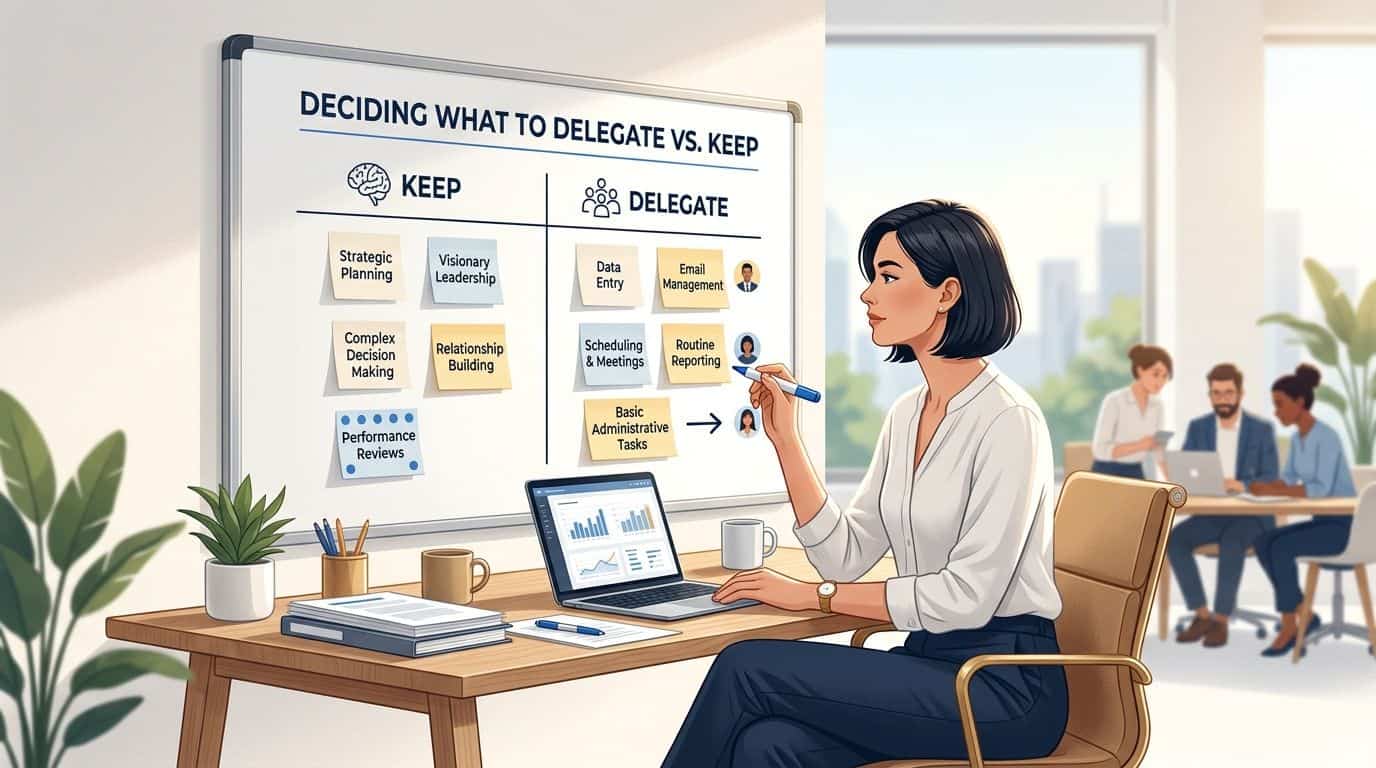
A useful way to look at your work is to sort it into four buckets:
- Work that requires your authority or judgment. Performance conversations, priority tradeoffs, sensitive stakeholder decisions. This stays.
- Recurring work that landed on you for historical reasons but doesn’t require you specifically. Weekly reports, meeting prep, status follow-ups, light analysis. This should be delegated.
- Work that’s useful for someone else’s development. Even if you could do it faster, doing it yourself robs someone of the growth opportunity. Delegate this with appropriate support.
- Work that shouldn’t be happening at all. Reports nobody reads, meetings that could be a message, processes that exist because they used to matter. Cut these.
Sorting is the bottleneck. So is documentation, once you realize the work in bucket 2 only lives in your head. AI is genuinely good at both.
Where AI Actually Helps
Five concrete uses. Each one solves a specific friction in the delegation process, not the abstract idea of “trusting your team more.”
Sorting the messy middle
The hardest part of delegation is the stuff in the middle, where you’re not sure if it’s bucket 2 or bucket 4, or if it should go to the senior person who’s swamped or the junior person who’s still learning.
Drop your task list, your recurring meetings, and your open Slack threads into your AI tool of choice and ask:
Sort this work into four buckets: stays with me, can be delegated now, can be delegated with support, or should be cut entirely. For each delegation candidate, suggest what kind of person would be best suited to take it on and what context they’d need to succeed.The output won’t be perfect. Some of what it suggests delegating will be things you should actually keep. Some of what it suggests cutting will be politically necessary. But the friction of staring at your own task list and deciding what to give away gets replaced with the much easier task of editing AI suggestions. Editing is faster than generating. For a deeper view of how prioritization and delegation interact, this piece on prioritization, delegation, and assignment is a useful reference.
Turning rough notes into a clean brief
The most common reason delegation fails: the manager hands off work verbally between meetings, the person nods, and they both walk away with different versions of what was just decided.
A written brief solves this. Most managers don’t have time to write one.
AI does this in 60 seconds. Dump your scattered notes, the Slack thread that started the project, and your half-formed thoughts about what success looks like. Ask the AI to turn it into a brief covering context, desired outcome, constraints, available resources, and what counts as done. Edit the output. Send it. That same upfront clarity is what makes writing a clear job description work, too.
This single use justifies most of the time you’d spend learning to use AI as a manager. A delegated task that only survives while you remember it has been temporarily outsourced, not delegated.
The same principle applies to anything that needs to land cleanly with another person: meeting agendas, project handoffs, kickoffs. A written artifact does work the manager’s memory can’t. If you’ve already built the habit for meeting agendas, delegation briefs are a natural extension.
Drafting better follow-up questions
Most check-ins fail because the manager asks “any update?” and the team member says “all good,” and nothing useful gets surfaced.
Better questions exist, but they’re harder to come up with in the moment. AI can help. Before a check-in, paste in what you know about the project and ask for three or four questions designed to surface risks the team member might not be raising on their own. If you want a starting set, there are some solid 1-on-1 prompts worth working from rather than starting cold. You’ll get back things like:
What’s the assumption you’re least sure about? Which dependency feels most fragile? Where would another set of eyes help most?
Pick one or two that feel right. Skip the rest. You don’t need to ask all of them. The goal is walking into the conversation with better starting moves than “how’s it going.”
Pre-handoff thinking
Before delegating something sensitive or unfamiliar, spend two minutes asking your AI tool to pressure-test your plan. Paste what you’re about to delegate, who you’re delegating to, and your reasoning. Ask what could go wrong and what you might be missing.
You’ll get back the obvious stuff plus occasionally something you genuinely hadn’t considered. The hit rate runs maybe 30-40%, which is high enough to be worth the two minutes, especially for delegations that matter.
Reformatting briefs for different audiences
If you’re delegating the same project to two people with different levels of context, you don’t need to write two briefs from scratch. Write one full version, then ask the AI to produce a shorter version for the person who already has background, or a longer version for someone newer. Edit and send.
This is rote work that used to eat half an hour. Now it’s ten minutes.
Where AI Doesn’t Help
This is the part most articles skip. Knowing what AI can’t do for delegation matters more than knowing what it can, because the wrong uses look productive while quietly making you worse at your job.
Picking who’s actually ready
AI can suggest who might be a good owner based on what you tell it. It cannot tell you who on your team is genuinely ready for the next level of autonomy.
That call requires things AI doesn’t have access to. How someone handles ambiguity. Whether they ask for help at the right moments or hide problems until they explode. How they react when their work gets challenged. Whether they’ve earned trust on the smaller things first.
Delegating someone into a job they haven’t earned yet sets them up to fail in a visible way and damages your judgment in their eyes when you have to walk it back. AI can help you draft the brief once you’ve decided who’s getting the work. The decision itself stays with you.
Replacing the conversation when something goes wrong
If a delegated project starts drifting, the move is to get on a call and figure out what’s actually happening. Drafting a polished AI-assisted message about expectations does the opposite of what you want.
The pattern I see most often: a manager notices something is off, reaches for AI to help them write a “course-correcting” message, the message goes out, the team member reads it as oddly formal and corporate, and trust takes a small hit on both sides. The drift that prompted the message remains, just now with extra layers of mediation.
When a delegation is going sideways, AI is the wrong tool. Pick up the phone.
Doing the thinking for delegations that need your judgment
There’s a temptation to use AI to think through delegations that you should be thinking through yourself. The pre-handoff pressure test mentioned earlier works fine for routine work. It falls short on a harder question that deserves you sitting with it for ten minutes.
Some delegations require honesty about whether you’re handing something off because it’s right for the person, or because it’s convenient for you. Whether it’s a stretch assignment or a problem you don’t want. Whether the timing is fair given what else is on their plate. AI can’t help with any of that, and trying to use it for those questions usually produces faster, shallower answers.
Performance conversations dressed up as delegation
The worst use I see of AI in this space is managers using delegation language to avoid difficult performance conversations. “I’m going to give you full ownership of this” can mean trust and growth, or it can mean I’m hoping you’ll figure out what I haven’t been able to tell you directly. AI doesn’t change which one is happening. It makes the message easier to write.
A performance issue needs to be addressed as a performance issue. Not as a redefined delegation arrangement. AI helping you avoid the harder conversation is AI making you worse at your job.
How to Delegate AI-Style: A Practical Week
Here’s what useful AI use looks like across one week of actual delegation work. Specific, concrete, and minimal.
Monday morning. Open last week’s notes, your task list, and any recurring meetings on your calendar. Paste them into your AI tool with a prompt like:
Sort this work into four buckets: stays with me, can be delegated now, can be delegated with support, or should be cut entirely. For each delegation candidate, suggest what kind of person profile would be best suited and what context they’d need.Edit the output. Pick three things to actually delegate this week. The rest of the suggestions can wait or get ignored.
Tuesday, brief-writing day. For each of the three delegations you’re making this week, pull your scattered notes, the project context, and your half-formed thoughts about what success looks like. Ask the AI to turn each into a delegation brief. Edit the output to sound like you, not the AI, then send.
Wednesday, delegation conversations. Have the actual handoff conversations. These are not the place for AI. You’re reading the room, gauging whether the person is excited or anxious, and adjusting on the fly. The brief you sent gives you something to anchor the conversation, not something to read aloud.
Throughout the week. When a check-in is coming up and you’re not sure what to ask, take 60 seconds to ask the AI for two or three questions designed to surface risks. Pick one. Walk into the conversation with that as your opener.
Friday afternoon. Pull what got delegated, what got followed up on, and where things drifted. This is the same end-of-week pattern that works well for building a weekly status update — same inputs, different output. Ask the AI:
What didn’t move this week that I should bring forward to next week? What patterns do you see in what got delayed?The pattern question is the valuable one. You’re too close to the work to spot the same kind of drift showing up across multiple delegations. AI catches it because it doesn’t have your blind spots.

The Trap
Using AI to stand in for the parts of the job that require you specifically is the failure mode worth watching for. The judgment calls. The harder conversations. The moments when sitting with discomfort matters more than routing around it.
Used the right way, AI gives you back hours every week. Hours that should go into the parts of management that only you can do. Reading your team. Making harder calls. Being present for the conversations that matter.
Used the wrong way, AI becomes a way to look productive while quietly distancing yourself from the people you’re supposed to be leading. The team always knows. They can tell when the message they got was something you actually thought about versus something the AI drafted on your behalf. They can tell when your “full ownership” handoff is real trust versus quiet abandonment. They can tell when the feedback in your check-in came from genuine attention versus an AI prompt you ran in the parking lot before the meeting.
Use AI for the work around the work. Not the work of managing people.
Bottom Line
Delegation runs on systems. Sorting work, writing clear briefs, picking the right owner, following up without surveilling. Most managers struggle with delegation because they’ve never built those systems. AI is genuinely good at most of the system parts.
The judgment parts stay yours. Who’s ready for what. When to have a hard conversation instead of writing one. Whether a delegation is a stretch assignment or a problem you’re trying to offload. AI can’t help you with any of that, and using it for those questions makes you a worse manager.
Get the split right and you’ll get hours back every week without losing the trust of the people you lead.
Frequently Asked Questions
How do I sort what to delegate when I’m too overwhelmed to even start?
That’s the exact situation AI is built for. Take 10 minutes, dump your task list, recurring meetings, and open Slack threads into your AI tool of choice, and ask it to sort everything into four buckets: stays with you, delegate now, delegate with support, or cut entirely. The output won’t be perfect, but editing AI suggestions is faster than generating them from scratch. The overwhelm usually comes from staring at the list without a framework to filter it.
What goes in a good delegation brief?
Six pieces: the context for why this matters, the desired outcome (not the activity), any constraints like deadlines or stakeholder sensitivities, links to relevant resources or examples, the boundaries of what the person can decide alone, and a clear definition of done. AI can turn rough notes into a brief covering all six in about 60 seconds. The point of the brief is that the work survives even if you’re offline for a day. If it can’t, the brief is incomplete.
Why does my team feel disconnected even when I’m delegating well?
Because efficient delegation and connected management are two different jobs. AI can make delegation mechanically smoother in measurable ways: better briefs, faster sorting, cleaner handoffs. Those gains don’t automatically translate into stronger relationships. If anything, they can create distance if you use the saved time to delegate more instead of being more present. Use the time AI gives you back for the parts of management it can’t help with: actual conversations, reading the room, being there when something hard comes up.
When should I avoid using AI in delegation entirely?
When the decision is about a person rather than a task. AI can help you draft a brief for someone you’ve already chosen, but it shouldn’t pick the owner. AI can help you outline a check-in but shouldn’t replace the conversation when something’s going sideways. And AI should never be involved in performance issues dressed up as delegation. “I’m giving you full ownership” used to avoid a hard feedback conversation is one of the worst manager moves available, and AI just makes the avoidance message easier to write.