
Most advice about employee recognition starts in the wrong place. It opens with tactics, gift cards, shout-out channels, employee-of-the-month programs, and then wonders why managers quietly avoid all of it. The tactics were never the problem. The problem is that most workplace recognition reads like corporate theater with emojis, and everyone in the room knows it.
Managers can feel this even when they can’t name it. You watch someone post “Huge shoutout to Sarah for all her hard work!” in the team channel and something about it lands wrong. It isn’t recognition. It’s a broadcast that the manager wanted to be seen recognizing someone. Sarah gets nothing from it, the team learns nothing from it, and the next real compliment gets a little harder to believe.
Good recognition does one thing the fake version can’t. It proves you were paying attention. That’s the entire difference. A message that names the specific decision, the actual impact, and something true about how that person works will land every time, even when it’s three sentences long. A message that could apply to half the team lands as noise, no matter how enthusiastic the punctuation.
This article covers why most recognition fails, the simple structure that fixes it, how to use AI to draft messages that sound like you instead of a greeting card, and a set of real employee recognition examples for the situations managers actually face: the project that didn’t work, the person who hates the spotlight, the employee coming off a rough stretch, and the quiet work that never gets noticed.
Key Takeaways
- Recognition sounds fake when it is vague, late, or sent through the wrong channel — the name-swap test catches it: if the same note could go to three other people unchanged, it is a template, not recognition
- The structure that works has three parts in order: Action (the specific thing they did), Impact (what changed because of it), Person (something true about how they work)
- The person part is what separates recognition from applause — and it is the one piece AI cannot supply, because it depends on actually knowing the employee
- AI drafts strong recognition only when you feed it real observations; four captured lines beat any cold “write a recognition message” prompt
- A light system — a running recognition log per direct report plus ten blocked minutes a week — feeds both daily praise and evidence-based performance reviews
Table of Contents
Why Most Recognition Fails
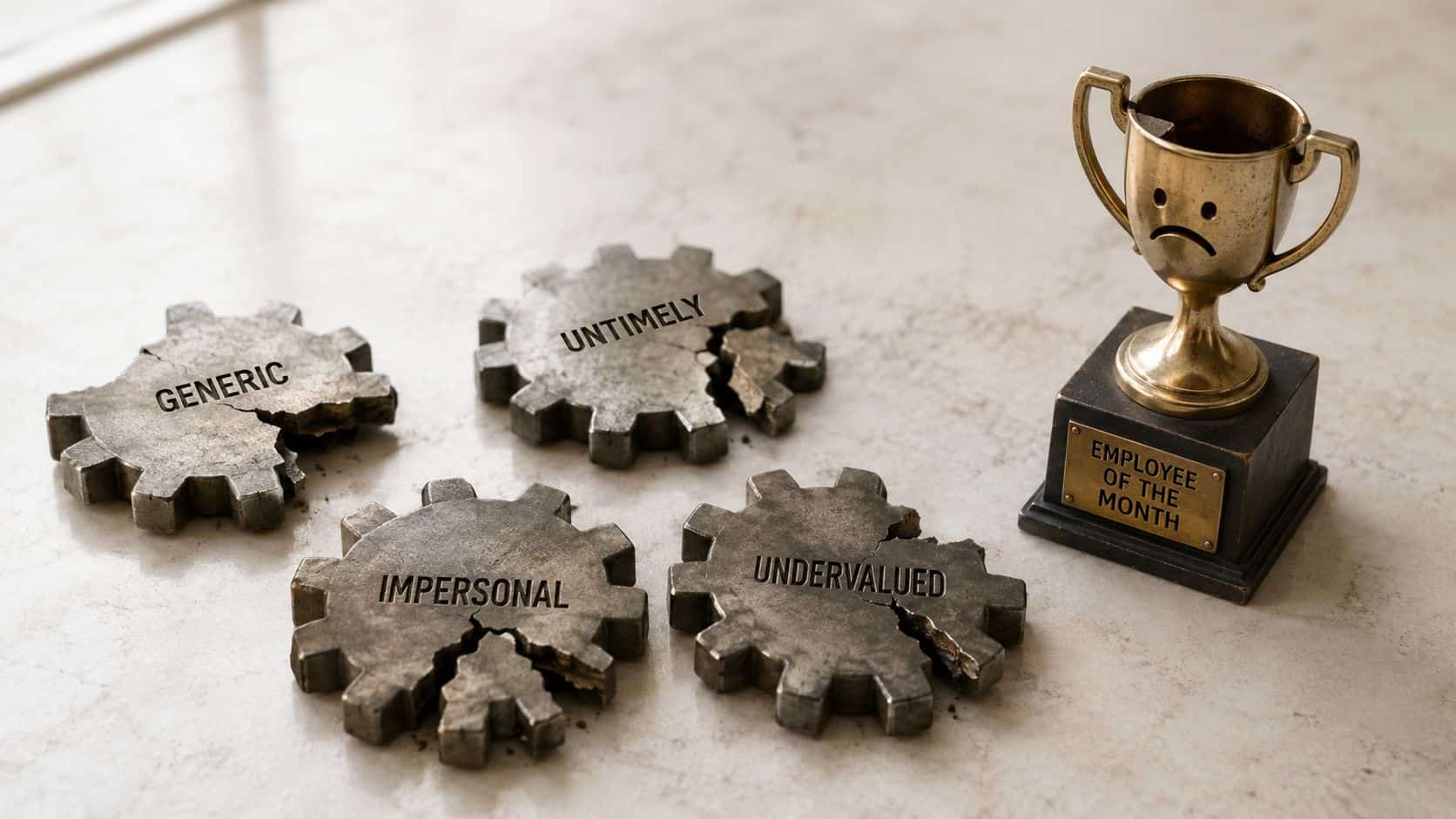
Managers don’t avoid recognition because they’re ungrateful. They avoid it because most of the recognition they’ve seen is bad, and they don’t want to add to the pile. It arrives late, says nothing specific, and sounds like it was written by a committee that fears plain English. Once you can name the failure modes, writing a good note gets a lot easier, because you know exactly what you’re steering around.
The stakes are higher than the genre’s reputation suggests. Recognition from a direct manager is the kind employees remember most, and organizations that take recognition seriously hold onto people meaningfully better than those that don’t, a pattern that shows up consistently in Gallup’s workplace research as summarized by Quantum Workplace. This is management work, not office decoration. Done well, it tells people what good looks like and gives them evidence their effort isn’t invisible.
Four failures account for almost all the bad versions.
Vague Praise
“Great job this week” gives the employee nothing to hold onto. If the message doesn’t name the decision, the behavior, or the extra care someone showed, it can’t reinforce anything. The practical test is the name swap: read the note again and ask whether you could send it to three other people without changing a word. If you could, don’t send it to anyone.
Wrong Channel
Public praise isn’t automatically better praise. It’s just more visible. A team-channel callout works when the behavior sets a standard others should copy and the person is comfortable being seen. Private recognition works better when the moment involved recovery, discretion, or growth in an area the employee still feels tender about. Some people would rather disappear into the floor than get a public shoutout, and sending one anyway is for you, not them.
Too Late
Recognition loses its force once the emotional moment has passed. Praise delivered weeks later feels processed instead of felt. The standard advice on authentic recognition is to deliver it close to the behavior, and the working compromise is simple: send a short note now, then give the fuller version later if the moment deserves one. Good work shouldn’t sit in your drafts folder until the next review cycle.
Generic and Copy-Pasted
AI didn’t invent empty praise. It just made it faster to produce. Feed a model “write a recognition message for Sarah” and you’ll get the same note every other manager got. The problem is the input, not the tool, and the fix is the subject of the AI section below.
Bad recognition doesn’t fail because employees are cynical. It fails because the message doesn’t prove the manager was paying attention.
The Anatomy: Action, Impact, Person
Good recognition is usually short. It just isn’t generic. The easiest structure to remember has three parts, in order: action, impact, person.
Start with the action: name the specific thing the employee did. Then the impact: what changed because of it. Did it clarify a decision, calm a customer, unblock another team, cut confusion in a handoff? End with the person: connect the moment to something true about how that employee works. That last part is what makes the message impossible to copy-paste.
The difference is easy to hear. The weak version says “Thanks for your hard work on the launch.” The stronger version says “Thanks for rewriting the onboarding email sequence before launch. The clearer language cut confusion in the handoff and gave support a cleaner script on day one. That’s a good example of how carefully you think about the experience after your part of the work is done.” Same moment, same employee, completely different effect. The second one tells the person what kind of strength you see in them.

The Person Part Is Where Most Managers Fail
Plenty of recognition gets the action and the impact roughly right, then collapses into fluff at the end. “You’re amazing” isn’t the person part. The person part is specific to that employee’s style, growth, or values, and it’s the piece that separates recognition from applause. Gallup’s guidance on recognition makes the same point: the most effective recognition is honest, authentic, and individualized to how each person wants to be recognized. That’s the direct argument against one-size-fits-all shoutout culture.
Individualized cuts two ways. It means the content fits the person, and it means the delivery does too.
Choosing Public or Private
Use public recognition when the contribution teaches the team something worth repeating and the employee is comfortable being visible. Use private recognition when the work involved personal growth, behind-the-scenes effort, or anything the person still feels tender about. When you’re not sure, ask. “Would you prefer I share this in the team channel or keep it between us?” costs five seconds and prevents the worst outcome, which is praise the person has to endure instead of enjoy.
The same channel judgment shows up everywhere in management, including the harder conversations. If your instincts get sloppy on stage-picking, they’ll be sloppy in tougher moments too, like when an employee disagrees with their review.
Match the Format to the Setting
Recognition should change shape depending on where it lands. In a 1-on-1, go deeper on growth and judgment, since that’s the best room for nuanced praise. In a team meeting, keep it tight: action, impact, done, before it turns ceremonial. In writing, add a little more specificity, because written recognition gets saved and reread. In a company-wide channel, strip the in-jokes and the context only your team understands.
The right recognition isn’t the loudest one. It’s the one the employee can accept without wincing.
Using AI to Draft Recognition That Sounds Like You
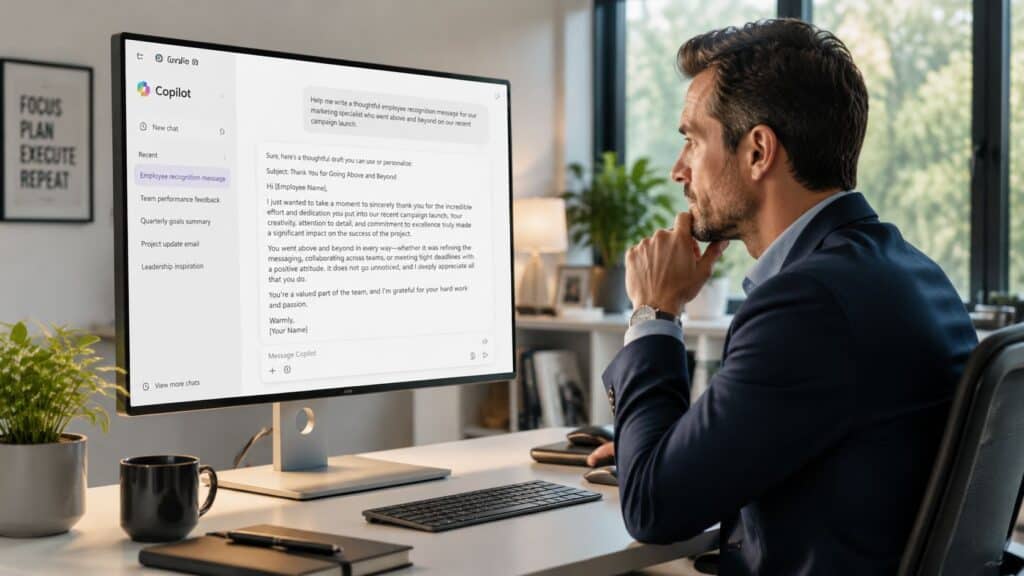
AI helps most with the part managers actually avoid, which is the blank page. ChatGPT, Claude, and Copilot are all good at shaping language once you hand them substance. None of them can supply the substance. Ask a model to “write a recognition message for Sarah” and you’ll get the same grateful mush every other manager got, because the input was mush. Feed it a real observation and the draft gets good fast.
The capture habit is the whole trick. When you notice something worth recognizing, you need about thirty seconds and four honest lines. The prompt below has the lines built in, so the only work is filling the brackets with what you actually observed:
Write a short recognition message for a direct report using the notes below.

Action (what they did): [specific thing you observed]
Impact (what changed because of it): [decision clarified, customer calmed, team unblocked, handoff cleaned up]
Person (something true about how they work): [their style, growth, or values — the part that makes it theirs]
Channel: [private Slack note, 1-on-1, team meeting, written note]
Anything to avoid: [phrases they’ve heard too often, attention they don’t want]

Keep it warm, plainspoken, and specific. Avoid HR language, hype, and clichés. Use the structure Action, Impact, Person. Give me three versions: one for a private Slack message, one for a 1-on-1, and one for a team meeting.
The “anything to avoid” line earns its place. It’s where you tell the model that this person has heard “great attention to detail” three reviews running, or that they’d rather not be praised for working late because they’re trying to stop working late.
Where AI Actually Helps
The model earns its keep on cleanup and variation. It removes stiffness from a draft that reads like legal copy. It generates channel variants so the Slack note, the review language, and the spoken version don’t all sound identical. It lowers the temperature when your draft sounds inflated, which matters because “you crushed it” applied to routine work weakens every future compliment. And it helps in the genuinely awkward cases: recognizing someone you respect but don’t naturally click with, or finding language for a small real step after someone’s rough month.
A few follow-ups worth keeping:
Rewrite this note in plain English. Keep it specific. Remove corporate clichés.Create five alternatives that don’t repeat the phrase "great work."Write this for someone I respect but don’t have natural rapport with. Sincere, not overly warm.If you want raw material for rotating your phrasing, a bank like HubEngage’s appreciation message examples is useful to adapt, never to copy. And the same evidence-first habit you’d use for ChatGPT prompts for performance reviews applies here at smaller scale: notes in, draft out, your judgment in between.
Where It Doesn’t
AI doesn’t know what the employee values. It doesn’t know whether public praise embarrasses them, whether this small win took real courage, or whether the person has heard the same line three times this quarter. That knowledge is the manager’s contribution, and it’s exactly the part the name-swap test checks for. The model writes the sentence. You supply the proof that someone was paying attention.
Employee Recognition Examples for Real Situations
Most recognition examples online only show polished wins, which is exactly when managers need the least help. The harder cases are the messy ones. Each example below follows Action, Impact, Person, and each is meant to be adapted, not copied. Run them through the name-swap test after you’ve made them yours.
When the Project Didn’t Work
“I want to call out how Priya handled the pricing test. The result wasn’t what we hoped for, but she built a clean experiment, documented her assumptions, and surfaced the weak points early instead of defending the idea. That saved us weeks on the wrong path. It’s one of her real strengths: she treats learning as part of the work, not as damage control.”
This is the example most managers never send, and it’s the one that shapes culture fastest. Recognizing a well-run failure tells the team that honest experiments beat defended ones.
Public Praise for a Visible Win
“Quick shout-out to Marcus for how he ran this release. He kept engineering, support, and ops aligned when scope changed late, and the handoff stayed clean because he documented decisions as they happened. Marcus is very good at making moving parts feel less chaotic for everyone else.”
Short, specific, done. Public recognition should end before it gets ceremonial.
Private Recognition in a 1-on-1
“One thing that’s improved a lot is how you frame risks early. In the last two planning meetings you raised issues while there was still time to solve them instead of waiting until the work was in motion. That changed the quality of the discussion, and it’s growth in an area you’ve worked on deliberately.”
Good private recognition sounds closer to high-quality feedback than to applause. The 1-on-1 is the right room for it, and it pairs naturally with the rest of your 1-on-1 meeting structure.
The Struggling Employee Who Did Something Well
“I want to pause on one thing you did well this week. The follow-up you sent after the client call was concise, accurate, and more confident than what we’d been seeing. It gave everyone a clear next step and kept the account from drifting. That’s worth naming, because it’s what strong execution looks like from you.”
The trap here is consolation. Praise for someone in a rough stretch has to sound earned or it makes things worse. Name the real thing, skip the pep talk.
Quiet, Consistent Work
“Sam rarely works in the loudest part of the process, but the team’s week goes better because he keeps operational details from slipping. The backlog cleanup he did this month made planning easier and killed a lot of duplicate discussion. He brings a consistency other people build on, even when they don’t see it directly.”
The people doing this work have usually watched louder colleagues get recognized for years. A specific note lands disproportionately hard.
Someone Outside Your Team
“Thanks to Jordan in finance for jumping in on short notice. He didn’t just answer the original question, he walked us through the underlying assumptions so we could make the call without coming back three more times. He has a habit of making complex things easier to act on.”
Copy their manager. Cross-functional recognition that reaches the person’s own boss is worth double.
Recognition Inside a Performance Review
“A recurring strength this cycle was Talia’s ability to create clarity in ambiguous work. The clearest example was the vendor transition, where she turned a loosely defined handoff into a concrete plan the team could execute. That wasn’t a one-off. It reflects how she operates.”
Review recognition names the pattern, not just the moment. That’s the difference between review language and a thank-you note, and it’s where your running notes pay off.
Build Recognition Into Your System
Recognition falls apart when it depends on mood and memory. It works when it’s part of how you already run the week. The gap between intention and practice is wide: most employees say they want more recognition than they get, and the fix isn’t caring more. It’s a mechanism.
The mechanism is light. Keep a running recognition log for each direct report wherever your management notes already live. When you send a note, copy the gist into the log. When you notice something but the moment isn’t right yet, capture the action-impact-person lines and come back to it. Block ten minutes a week so it doesn’t depend on remembering. That’s the whole system.
The log pays off twice. First in the moment, because you send more recognition when the raw material is sitting there. Second at review time, because daily recognition and review language are related but different jobs. Daily recognition says “that mattered.” A review says “here’s the pattern.” A manager with a quarter of logged moments writes evidence-based reviews instead of reconstructing a year from impressions, and the same log feeds straight into growth conversations when it’s time to build an employee development plan.
One more reason the habit compounds: recognition and honest feedback are the same muscle. Both depend on noticing specifics and saying them plainly. A manager who’s specific in praise earns the credibility to be specific in criticism, and a team that trusts your recognition gives you better upward feedback in return, because they’ve seen proof you pay attention.
Recognition platforms can help with visibility and peer recognition, but treat the software as plumbing. The core work is still observation, judgment, and message quality. No tool writes the person part for you.
The Cheapest Habit in Management
Recognition done well costs almost nothing. No budget line, no platform, no program approval. A few specific sentences, sent close to the moment, in the channel the person can actually accept. That’s the entire investment, and the return shows up everywhere: people learn what good looks like, effort stops feeling invisible, and your harder feedback lands better because your praise has already proven you watch closely and say what’s true.
The reason most managers never collect that return is that they’re waiting to feel inspired, and inspiration is unreliable. The version that works is mechanical in the best sense. Notice something real, capture four lines, let AI shape the draft, fix the person part yourself, send it through the right channel. Repeat weekly. None of it requires being a naturally warm communicator. It requires being someone who pays attention and says so.
That’s also the test for every message before you hit send. Strip away the enthusiasm and ask what it proves. If it proves you noticed the specific thing this specific person did, send it. If it could go to anyone, it’s theater, and your team can tell the difference faster than you can.
Frequently Asked Questions
What makes employee recognition sound fake?
Vagueness, mostly. If the message doesn’t name a specific action and its impact, it reads as obligation instead of observation. The quickest test is the name swap: if you could send the same note to three other people without changing a word, it isn’t recognition, it’s a template. Timing and channel make it worse, since praise that arrives weeks late or on the wrong stage feels processed rather than felt.
How do I write a good employee recognition message?
Use three parts in order: action, impact, person. Name the specific thing they did, explain what changed because of it, then connect it to something true about how that person works. The last part is where most managers fail, and it’s the piece that makes the message impossible to mistake for a template. Keep it short. Three specific sentences beat three paragraphs of enthusiasm.
Should employee recognition be public or private?
It depends on the moment and the person. Public works when the behavior sets a standard worth copying and the employee is comfortable being visible. Private works better for recovery, behind-the-scenes effort, or growth in an area someone still feels tender about. When you’re not sure, ask them directly. Five seconds of asking beats praise the person has to endure.
Can I use AI to write recognition messages?
Yes, if you supply the substance. Feed ChatGPT or Claude your real observations using the action, impact, person structure and the draft gets good fast. Ask it cold to “write a recognition message” and you get the same grateful mush as everyone else. AI handles the phrasing and the channel variants. It can’t know what the employee values or whether public praise embarrasses them, so that judgment stays with you.