
Picture the conversation that should be easy. A strong direct report tells you they want to grow. The direction is even reasonably clear, more senior scope, or a shot at management, or deeper technical credibility. You nod, you agree, you mean it. The meeting ends, the calendar rolls on, and a week later you’re staring at a blank doc that’s supposed to become their development plan.
That blank doc is where most employee development plans quietly die. Not because the manager doesn’t care. Because turning a messy human conversation into a concrete plan takes time you don’t have. The notes are partial. The priorities are fuzzy. The person said three things that might matter, and only one of them should actually drive the next quarter.
This is the gap AI is good at closing, as long as you keep it in the right role. Claude, ChatGPT, and Copilot are strong at structure, synthesis, and drafting. They turn rough notes into a usable first pass, suggest role-specific milestones, rewrite vague goals into observable ones, and produce check-in templates that save you the administrative slog. What they can’t do is tell you whether the person is genuinely hungry for promotion, quietly burned out, or mostly just wants more stability. That read belongs to you, and it’s the part that actually makes the plan work.
The effort is worth it because the alternative is leaving growth as a vague promise. There’s solid evidence that companies running real, structured development see meaningfully higher productivity and revenue per employee than those who leave it informal, which Devlin Peck’s roundup of training statistics lays out. The point isn’t to bury someone in coursework. It’s to turn “I want to grow” into something that changes their work next month.
This guide covers how to run the conversation that gives AI something real to work with, how to draft the plan from raw notes without getting generic filler back, three worked examples on a 30-60-90 structure, and how to keep the plan alive instead of letting it rot in a forgotten doc.
Key Takeaways
- AI is strong at structuring and drafting an employee development plan, but it can’t read whether someone is genuinely ready for promotion, quietly burned out, or just wants stability — that judgment stays yours
- The conversation is the input AI can’t generate: separate the skill gap (perform better now) from the interest gap (curious or energized), because confusing the two produces the wrong plan
- Feed AI operator-grade context — role, strengths, observed gaps, stated goals, constraints, time horizon — and demand observable, accountable goals instead of “make an IDP for my employee”
- Anchor the plan to 70-20-10 (most growth from on-the-job work) on a 30-60-90 structure; if the draft is mostly courses, it’s built backwards
- A plan only works if it lives where the work happens: rewrite vague goals into visible actions, track monthly in one-on-ones with a quarterly reset, and treat the plan as a compass, not a fixed map
Table of Contents
The Conversation Is the Data AI Can’t Generate

AI can reorganize a career conversation. It cannot have one for you, and it cannot rescue a weak one. If you walk in with vague notes, you get a vague plan back, dressed up in cleaner language. The most valuable input to a development plan isn’t a competency matrix or a template. It’s the human detail you pick up in the conversation itself: whether the person wants scope, a title, mastery, visibility, less chaos, or a quiet exit from their current lane. Without that, the model produces polished nonsense.
The timing pressure is real too. A meaningful share of the skills today’s roles depend on will shift within a few years, a point Benepass makes in its discussion of development plans. That means a plan built only around the current role’s checklist ages badly. The plan has to connect what the person does now with where they’re actually trying to go.
Separate the Skill Gap From the Interest Gap
The most useful distinction in this whole process, and the one managers most often blur, is between a skill gap and an interest gap.
A skill gap is something the person needs to perform better in their current role or a clearly defined next one. Running cleaner stakeholder updates. Improving technical design quality. Handling conflict in cross-functional work. Delegating instead of doing.
An interest gap is something they’re curious about or energized by. Trying management. Exploring product strategy. Speaking externally. Mentoring newer teammates.
Both matter, but they call for completely different responses, and confusing them produces bad plans. The person who wants to manage someday gets sent to a generic feedback course. The person who actually needs stronger execution gets put on a “career exploration” track instead of the concrete support they need. When you mix up curiosity with readiness, you assign the wrong work to the wrong motivation.
One line worth keeping in mind: curiosity about management is not commitment to management. “I think I’d like to manage someday” is a different statement from “I’m ready for people responsibility next quarter,” and a good plan treats them differently.
Questions That Give AI Something Real to Work With
This doesn’t need to turn into therapy, but it does need to get specific. A few questions that pull out the raw material AI can’t infer:
- On direction: “What kind of work do you want more of over the next few months?”
- On motivation: “Are you after promotion, more mastery, more autonomy, or just less friction?”
- On constraints: “What part of your current role is making growth harder right now?”
- On evidence: “What feedback have you heard more than once?”
- On trade-offs: “Would you rather go deeper in this role or test a different kind of responsibility?”
The answers are the thing you feed the model later. If you skip the conversation and start with the template, you’re asking AI to invent the one input only the person could give you. Capture the conversation cleanly while it’s fresh, since a sloppy summary produces a sloppy draft no matter which model you use, and a short written recap right after the meeting is usually enough, a habit worth building the way you would for any meeting where decisions need to stick. Managers who already run solid one-on-ones can sharpen this intake further with ChatGPT prompts for 1-on-1 meetings, since the strongest development plans usually come out of a series of conversations rather than one big annual sit-down.
Drafting the Plan From Raw Notes
This is where AI earns its place, in a narrow role. It isn’t a coach and it isn’t a decision-maker. What it does well is produce a fast first draft, and the trick is giving it operator-grade input instead of consumer-grade input. “Make an IDP for my employee” gets you generic mush. A structured packet of real context gets you something you can actually edit into a plan.
A useful input packet includes the role and level, the person’s reliable strengths, the gaps you’ve actually observed, what they said they want next, the business reality (current projects, staffing limits, roadmap timing, available mentors), the time horizon, and the exact output format you want back. The more of that you supply, the less the model has to invent. The same operator mindset that makes AI training for employees actually stick applies here: context and constraints in, useful output out.
It also helps to anchor the plan to a development model that keeps it tied to real work rather than a course catalog. The 70-20-10 split is a good default, where most growth comes from on-the-job experience, a chunk from coaching and peer learning, and only a small slice from formal training, an operating frame TMI lays out in its guide to development plans. If the AI’s draft is 80% courses, it’s built backwards.
A Prompt That Actually Works
This kind of structured prompt produces a far better draft than a one-liner:
Create a draft employee development plan for a direct report based on the notes below.
Role and level: [role]
Team context: [current business priorities]
Strengths: [strengths]
Skill gaps to address: [observed gaps]
Interests and aspirations: [what they said]
Constraints: [time, staffing, budget, promotion timing, workload]
Build a practical 30-60-90 day plan, separated into:
1. Stretch assignments and on-the-job development
2. Coaching, mentoring, and peer learning
3. Formal training or reading
4. Monthly check-in questions
5. Signs the plan needs adjusting
Keep the language direct and manager-friendly. No generic corporate wording. Make every goal observable and accountable.
That gets the model behaving like a sharp chief of staff instead of a motivational poster generator. The “observable and accountable” instruction is doing real work, because the default failure mode is vague goals nobody can check.
Where the First Draft Goes Wrong
Even good models make predictable mistakes on these, and knowing them in advance saves you an editing cycle:
- Too generic: “improve leadership presence” with no visible action attached.
- Too ambitious: it loads up someone who’s already underwater.
- Too training-heavy: it reaches for courses instead of changing the actual work.
- Wrong level: it hands staff-level expectations to someone still nailing core execution.
The fix is a quick refinement pass. Any of these as a follow-up tightens a weak draft:
Rewrite this plan for a busy team with limited spare time.
Reduce the formal training and increase on-the-job practice.
Make each milestone observable by a manager in a monthly one-on-one.
Replace the vague leadership language with specific behaviors.
Clean notes in, structured draft out, and the same note-to-draft handoff works faster if you borrow a workflow from ChatGPT prompts for 1-on-1 meeting notes.
Three Worked Examples

Examples are where this stops being abstract. The pattern is identical each time: start from the conversation, feed the rough material to AI, then edit the draft so it fits the actual person and the actual work. The editing is where your judgment shows up.
A Backend Engineer Growing Toward Senior
The notes: mid-level backend engineer, strong execution, reliable in incident response, wants senior scope. Says the hardest part is influencing design decisions early instead of just implementing them. Peer feedback calls the technical work strong but the cross-team communication uneven.
The prompt:
Draft a 30-60-90 day development plan for a mid-level backend engineer growing toward senior. Focus on system design participation, stakeholder communication, and technical ownership. Include stretch work, coaching support, and light formal learning. Keep every goal manager-friendly and observable.The AI draft was reasonable: shadow design reviews, own a scoped service improvement, lead a design review by day 90, plus a suggested technical-communication course. The problem is “own a scoped service improvement” is generic, and the course was filler for someone who learns by shipping.
The manager’s edit is the whole point. “Own a scoped service improvement” became “lead the retry and alerting cleanup project already on the roadmap,” a real stretch assignment with visible stakeholders. The course got cut. And the key check-in question became “where did you influence the design before coding started?” That question tests the actual development goal, not just activity.
A Senior UX Designer Considering Management
This is the common case where management sounds attractive mostly because it looks like the next step up. That isn’t the same as wanting the job. The notes: senior designer, excellent with product partners and research synthesis, already mentors informally, curious about leading people but unsure about the administrative side. Wants to test leadership without committing to the path.
The prompt:
Build a 30-60-90 day development plan for a senior UX designer exploring people management. Test management responsibilities without assuming a formal transition. Include trial leadership experiences, coaching, and clear review questions to judge fit.The AI draft was too soft: facilitate design critique, mentor a junior designer, read management material, reflect on the experience. “Mentor a junior designer” can mean anything, and “read management material” usually means nothing changes.
The manager’s edit made the experiments real. Run design critique for a defined period and own the agenda and follow-up. Lead onboarding for one new designer so the person sees the repetitive support side of leadership, not just the high-status parts. Handle one difficult peer feedback conversation with coaching beforehand, because management interest tends to rise or fall on conflict. The review questions got sharper too: which parts felt energizing, which felt draining, did they enjoy growing people or mainly enjoy being seen as senior? That produces signal instead of theater.
A Manager Building Technical Fluency
Common in marketing, operations, and customer success: a manager who’s strong with people and process but wants enough technical depth to lead credibly. The notes: new marketing manager, good at coordination and planning, weaker on analytics tooling, wants technical fluency so team discussions don’t depend entirely on one specialist. Doesn’t want to become the hands-on expert, just fluent enough to ask better questions.
The prompt:
Create a 30-60-90 day development plan for a marketing manager building technical fluency in analytics and experimentation. Keep the focus on leadership usefulness, not turning them into a hands-on specialist. Use concrete work-based practice at each milestone.The AI draft leaned classroom-heavy: learn the platform, shadow an analyst, complete formal training, present a review. The manager rebuilt it around real work: sit with the team analyst to map what each key metric actually drives in decisions, co-lead one campaign retro explaining what the numbers mean and what action follows, then propose one simple experiment with defined success criteria. The manager added a guardrail too, that the goal isn’t to out-specialist the specialist, just to manage trade-offs and ask sharper questions. That protects the person from the “manager must be best at everything” trap.
What the Three Share
Across all of them, the useful plan starts from a real conversation, separates aspiration from readiness, uses current team work as the development engine, keeps formal training in a supporting role, and creates signals you can observe without hovering. The tools differ at the margin: Claude tends to be stronger at long-form synthesis, ChatGPT is quick for iterating and rewriting goals, and Copilot is convenient when the evidence is scattered across Teams, Outlook, and Word. If you’re keeping development notes aligned with formal review language, the workflows in Microsoft Copilot for performance reviews carry over directly.
From Draft to Trackable Goals
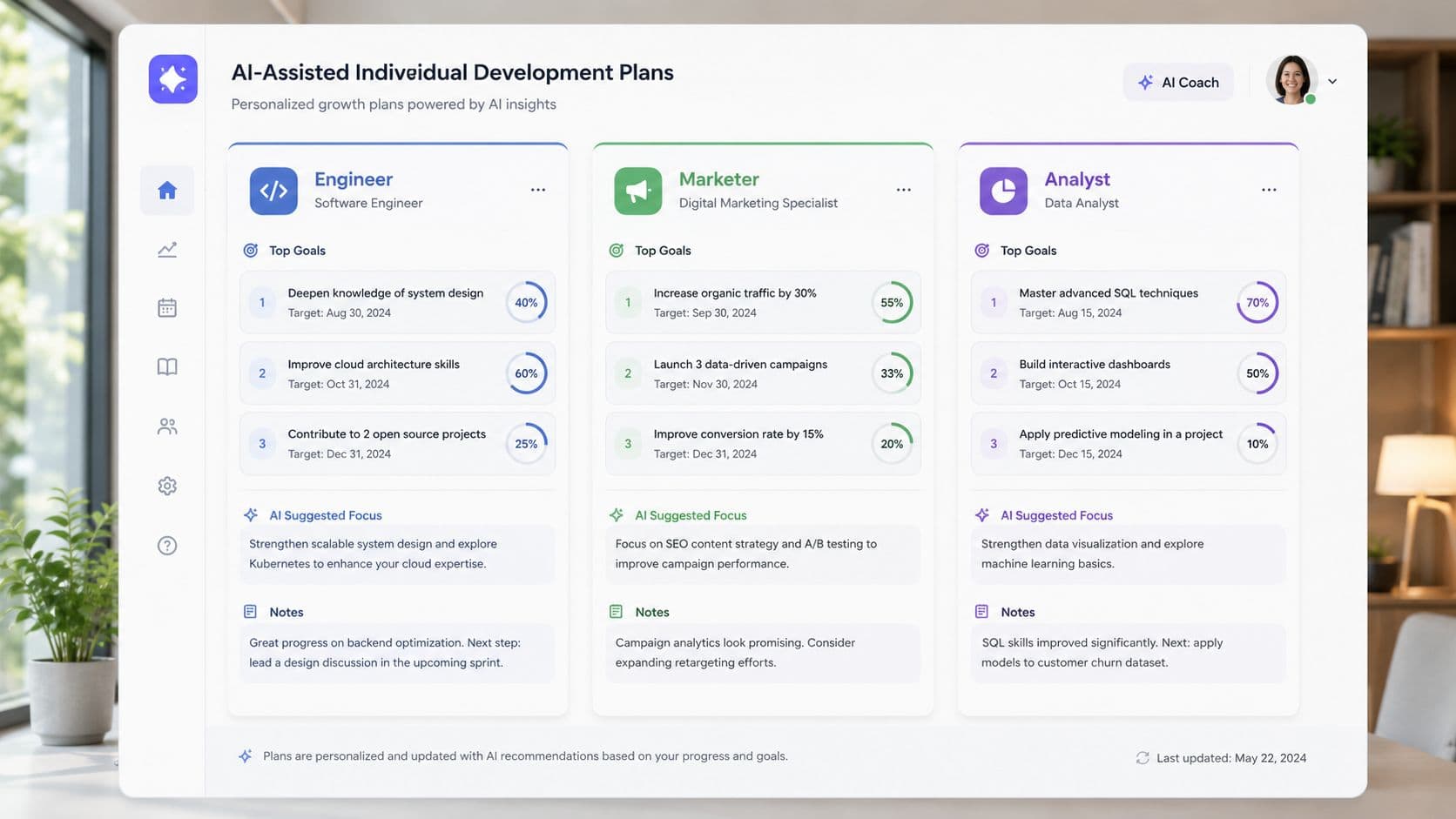
A draft isn’t a plan until it lives somewhere the work already happens. If it sits in a forgotten doc, the development plan becomes one more nice conversation with no follow-through. Two habits keep it alive: rewriting the goals into visible actions, and tracking them without turning into a hall monitor.
Rewrite Vague Goals Into Visible Actions
Assume the AI’s first draft reads better than it operates. The fix is to convert every goal into something you could actually observe in a one-on-one. A few examples of the move:
- “Improve executive communication” becomes “present the next project update in the team-wide demo and send a one-paragraph summary to stakeholders afterward.”
- “Develop strategic thinking” becomes “bring two recommendation options and one trade-off analysis to the next roadmap review.”
- “Build leadership skills” becomes “mentor the new teammate through their first project kickoff and gather feedback after.”
The rewritten versions are easier to discuss because you can ask what happened, what they learned, and what should change next. The vague versions give you nothing to talk about.
Track Without Hovering
Micromanagement usually starts when the plan is vague. You can’t tell whether progress is real, so you over-check. The cleaner setup is to make the milestones visible in whatever system your team already uses, so progress shows up on its own. Put the 30-60-90 milestones somewhere trackable, store the narrative plan and reflection notes alongside it, and protect a recurring slot in your one-on-ones to talk through it. A development plan should create shared visibility, not constant supervision.
A practical cadence, drawing on what Cypher Learning describes as effective practice, is monthly check-ins inside your existing one-on-ones with a fuller reset each quarter. Monthly keeps momentum without making growth feel like surveillance. Quarterly gives enough room for the plan to actually change as the person and the work change.
Keep the HR System in Its Place
Some companies want the final plan reflected in a formal platform. That’s fine, but those systems are the record, not the workshop. The thinking happens in your notes and your one-on-ones; the platform just stores the agreed version. Draft and refine where you actually work, turn milestones into visible commitments, discuss them monthly, then copy the agreed version into the HR system if your company expects it and update it at the quarterly reset.
That satisfies the process without letting the plan go dormant inside a tool nobody opens between review cycles. A simple leadership development plan template can give you a starting structure, but remember the template is scaffolding, not judgment, and it’s only useful after the conversation, never before it.
The Plan Is a Compass, Not a Map
A good development plan shouldn’t lock someone into a script they wrote three months ago. Roles change. Teams get reorganized. A direct report discovers they don’t want management after all. A stretch assignment falls apart because priorities shifted. None of that means the plan failed. It means the plan is doing its job as a direction, not a fixed route.
This is where AI’s real value shows up, and it isn’t just faster setup. It’s easier revision. When someone’s situation changes, you paste the latest notes back into Claude, ChatGPT, or Copilot and ask for a revised version with updated milestones and check-in prompts, in plain language. Plan maintenance stops being a chore you avoid and becomes a five-minute management task you actually do.
The hard parts stay yours, which is the whole point. Reading ambition correctly. Noticing hesitation the person won’t say out loud. Deciding whether someone needs a challenge, more support, or a reset. AI has no access to any of that. What it removes is the paperwork friction, the blank-doc paralysis, the formatting, the rewriting of vague goals into observable ones.
That trade is worth taking every time. The less time you spend formatting development plans, the more time you have for the part that actually grows people: the honest feedback, the well-chosen stretch assignment, the conversation that helps someone make a smarter move than they would have made alone. The plan is just the structure that keeps those conversations pointed in the same direction quarter after quarter.
Frequently Asked Questions
What is an employee development plan?
It’s a practical roadmap for how a specific person will grow over a set period, usually the next quarter. A good one ties real on-the-job work to where the person is actually trying to go, with observable milestones instead of vague goals. The test is simple: if the plan doesn’t change the person’s work in the next month, it isn’t really a development plan.
How do I use AI to write a development plan?
Run the career conversation first, then feed AI the real inputs: role and level, strengths, observed gaps, what the person said they want, your constraints, and the time horizon. Ask for a 30-60-90 plan split into stretch work, coaching, light formal training, and check-in questions, with goals kept observable. The first draft will need editing for realism, but it saves you the blank-doc setup time.
What is the 30-60-90 structure?
It’s a plan broken into what happens in the first 30 days, the next 60, and the next 90. Early milestones are small and observational, later ones are real stretch assignments tied to actual team work. It keeps growth concrete and gives you natural check-in points in your monthly one-on-ones.
Where does AI stop being useful?
At the judgment. AI can structure and draft, but it can’t tell whether someone is ready for management or just curious, whether they’re ambitious or burned out, or whether they need a challenge versus a reset. It also can’t separate a skill gap from an interest gap for you. Those reads come from the conversation, and they’re the part that makes the plan actually fit the person.