
Nobody picks between Perplexity and Claude as their only AI, which makes most Perplexity vs Claude comparisons answers to a question no manager is asking. The real decision sits one seat over. You already have a generalist, whether that’s ChatGPT on your own card or the Copilot your company deployed, and the question is which specialist earns the seat beside it. The answer tracks whether your hard problem is knowing things or saying things.
Perplexity is the research engine, built to answer what’s true and current outside your company, with sources attached to every claim. Claude is the writing and reasoning partner, built to take the material you already have and turn it into analysis, decisions, and messages that land well with the people who read them. Ask both tools to do the same job and you’ll waste a morning comparing outputs that were never designed to compete. The cleanest proof that this was never really a versus comes from Perplexity itself, which offers Claude’s models as an option for writing its own research answers. One contestant literally runs the other’s brain.
So this comparison decides the seat rather than crowning a model. The rule that settles most days comes early, when each tool clearly wins, the handoff workflow that uses both, and the persona picks for the manager who wants the one-line answer. Evidence and judgment are different jobs. The rest is knowing which one is in front of you.
Key Takeaways
- Perplexity vs Claude is not really a duel; it is a question of which tool earns the second seat next to whatever you already use every day.
- Perplexity wins when evidence is the job: market scans, vendor research, and anything where you need current sources you can click and verify.
- Claude wins when judgment is the job: performance reviews, sensitive messages, and long documents where tone and reasoning across a lot of context matter.
- Both cost about $20, so price will not settle it. Pick by which failure mode you can live with: a shaky citation or a confident answer with no source.
- The strongest pattern is a handoff rather than a choice: research once in Perplexity, condense it into a fact brief, then draft once in Claude.
Table of Contents
The Second Seat, and the Rule That Fills It
Picture the decision in the wild. Tuesday morning, a manager preparing a vendor recommendation needs three things before noon. What the market actually charges for this category, how the two finalists handle security, and a memo that will survive the CFO reading it closely. The first two are research problems. The third is a judgment problem. That’s the whole comparison in one meeting prep, and it’s why the seat question beats the versus question.

What each tool actually is
Perplexity launched in 2022 as an answer engine, and everything about it serves the moment when you need current, checkable information from outside your walls. It searches as you ask, pulls the findings together across sources, and attaches citations to claims so you can follow the trail. The Perplexity guide for managers covers the day-to-day, and the short version is that it behaves like a research analyst who shows their work, and getting the best out of that analyst rewards structured research prompts over lazy one-liners.
Claude arrived in March 2023 from Anthropic and grew into the careful thinker of the assistant field. Its strengths run long and deep rather than wide. It thinks through long problems without losing the thread, holds a steady tone across pages, and takes a quarter’s worth of material in one conversation, with current limits running 200K tokens as standard and up to 1M on the newest paid models. Feed it your notes, transcripts, and drafts, and it produces analysis and writing that needs noticeably little repair before a human reads it.
| Perplexity | Claude | |
|---|---|---|
| Built to answer | What’s true and current out there? | What should I make of what I have? |
| Where the value comes from | The live web, cited | Your own material, reasoned through |
| Strongest output | A sourced research brief | A finished document or hard analysis |
| Main risk | Confident summary of a weak source | Confident prose with no receipts |
The rule
Both tools cost about $20 a month at the Pro tier, so price decides nothing. What decides is who the work is for. Work that will face an audit goes to Perplexity, because “where did this number come from” needs a link, and its whole design is keeping claims attached to checkable sources. Work that will face a person goes to Claude, because a performance review, a stakeholder memo, or a difficult message is judged on precision and tone, and that’s the work Claude needs the least editing on. Say it shorter. Evidence for auditors, judgment for humans, and the rest of this piece is that rule applied.
How They Stack Up on a Manager’s Actual Work
Run the two tools across the tasks that fill a manager’s week and the pattern gets almost embarrassing in its consistency.
| Task | Winner | Why |
|---|---|---|
| Market and vendor research | Perplexity | Live search with citations; built for exactly this |
| Making sense of your own documents | Claude | The long context takes months of material whole |
| Reviews and sensitive feedback | Claude | Tone control that survives a close reading |
| Claims someone will challenge | Perplexity | Every number arrives with its source attached |
| Quick factual lookups | Perplexity | Faster than opening three tabs |
| The final memo or decision doc | Claude | Judgment work, and judgment is the product |
Two rows deserve the honest asterisks. The your-own-documents row assumes the material is yours, meaning notes, transcripts, reports, and drafts that already live inside your walls. Claude takes that stack in one conversation and reasons across all of it, which is the workflow behind the Claude for performance reviews guide and the reason writing-heavy managers get attached to it. The moment the work needs outside facts woven in, the honest answer becomes both tools in sequence, and that handoff gets its own section below.
The research row carries the reverse asterisk. Claude can search the web now, and for casual lookups the gap has narrowed. It hasn’t closed where it counts. Perplexity’s answers come back organized so you can check them, with claims tied to sources you can open, while Claude’s research reads more like a well-informed colleague’s summary. For anything you’d defend in front of a skeptical audience, the analyst who shows their work beats the colleague who remembers well.
Under the hood, both platforms are moving targets in the same direction. Claude’s current lineup runs Sonnet 5 as the everyday default with Opus 5 as the flagship, and Perplexity’s Pro tier lets you pick among frontier models, including Claude’s own, for writing its research answers. Which is the detail worth sitting with for a second. The companies themselves treat research and writing as two different jobs, one gathering the evidence and one doing the thinking, and a manager choosing a second seat is making the same call at the workflow level.
Four Real Weeks, Four Seat Decisions
The rule is easiest to trust after watching it work. Four scenarios from actual manager weeks, each ending in the seat it settles.

| Scenario | The work | The seat |
|---|---|---|
| Vendor evaluation | Outside facts, then an inside memo | Both, in sequence |
| Performance review season | Your notes, careful words, a human reader | Claude |
| Market scan for the exec deck | Current numbers someone will challenge | Perplexity |
| The transcript backlog | Six meetings of material, one decision needed | Claude |
The vendor evaluation
The task from the intro, played out. Market pricing and security answers are Perplexity work, and twenty minutes of structured queries returns a sourced picture of the market you could show procurement. The recommendation memo is Claude work, because the CFO isn’t grading your citations, they’re grading whether the reasoning holds and the tradeoffs are stated like someone who understands them. Managers who run this on one tool get either a memo with weak evidence or a research dump with no argument. The sequence gets both, and the handoff section below turns it into three prompts.
Performance review season
The clearest Claude week of the year. The material is yours, the reader is a person, and the stakes punish generic writing. Claude takes the full cycle of notes and drafts language that sounds like a thoughtful manager rather than a template, and the Claude review prompts run that exact workflow. Perplexity has close to nothing to offer here, which is the point. A specialist that’s honest about its lane is worth two generalists that aren’t.
The market scan
The exec deck needs the competitor pricing slide, and someone in that room will ask where the numbers came from. That question decides the seat before you open a tab. Perplexity returns the scan with sources attached, you spot-check the three claims that matter most, and the slide survives its audience. If your everyday assistant is ChatGPT and you’re wondering why it shouldn’t just do this, the Perplexity vs ChatGPT comparison answers that exact question at length.
The transcript backlog
Six meetings across two weeks, one hiring decision waiting, and the real question buried somewhere in all that conversation. This is long-context work, and it’s Claude’s clearest built-in advantage. The whole stack goes in at once, the analysis connects what was said across meetings instead of within them, and what comes out is one answer with the reasoning attached, rather than six summaries. If your generalist is strong and you’re tempted to skip a specialist entirely, the ChatGPT vs Claude matchup maps where the generalist genuinely suffices and where it doesn’t.
The Handoff: Research Once, Draft Once
When the work needs both evidence and judgment, the failure mode is pasting Perplexity’s entire output into Claude and hoping. The sequence below is deliberate about what crosses the handoff, and the middle step is the one most managers skip.
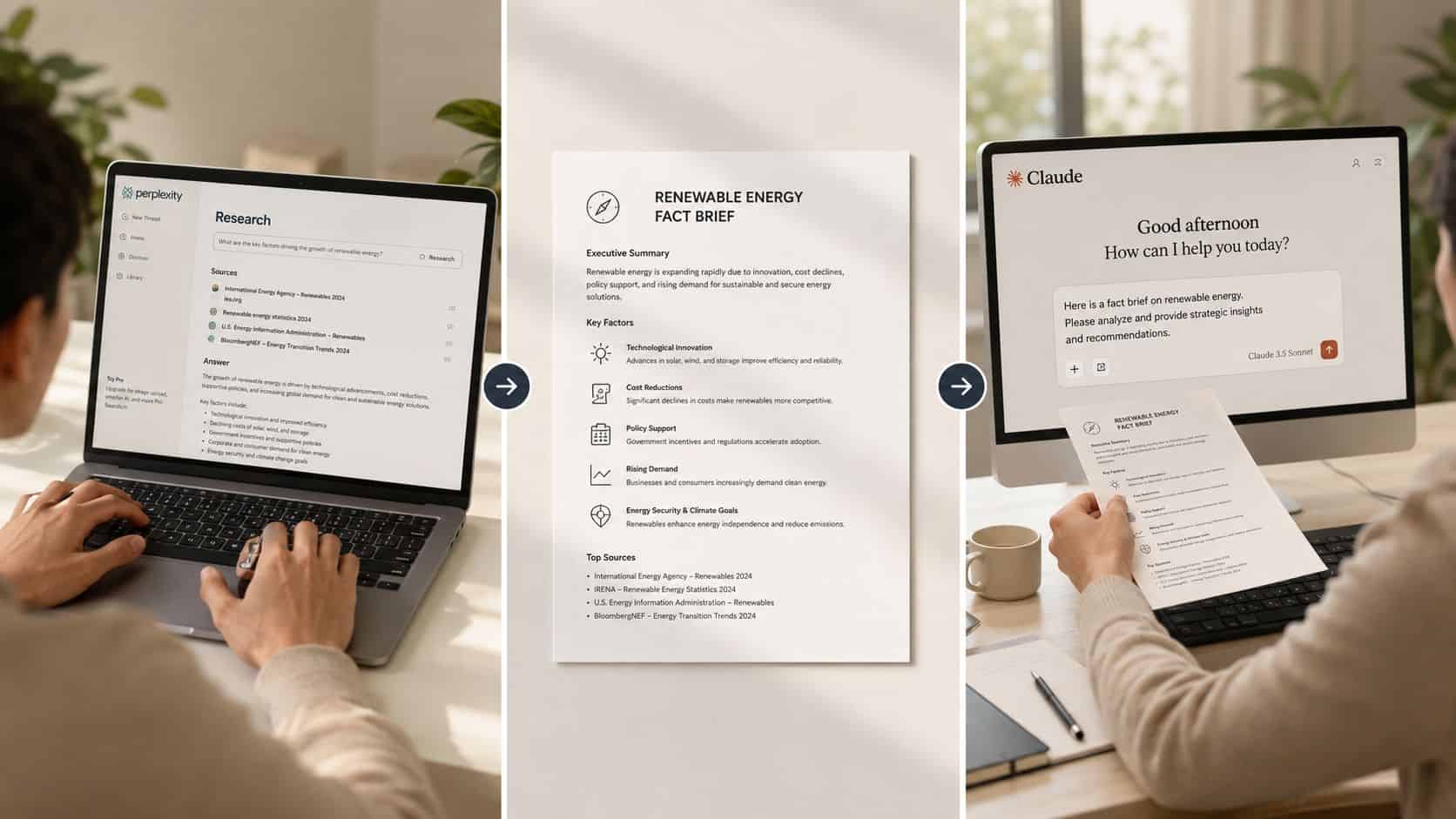
Gather (Perplexity):
Research current market pricing for [category], how the main options are hosted, and what security certifications they hold. For each claim, include the source. Prefer official vendor pages, industry analysts, and reviews from real buyers within the last 18 months. Flag anything where sources disagree.Compress (Perplexity):
Condense this research into a fact brief. List each finding as one line with its source. Separate confirmed facts, contested claims, and gaps where evidence was thin. No recommendations, no narrative.Draft (Claude):
Using this fact brief and my context below, write the recommendation memo. My context: [what my team needs, the real budget, what has to work with our existing tools, how much risk we can live with]. Argue for one option, state the tradeoffs honestly, cite the brief's facts where they carry weight, and flag which facts most deserve a second check before we commit.The compress step earns its place by protecting the draft from research sprawl. A fact brief crosses the handoff clean, with contested claims already labeled, so Claude reasons from evidence instead of summarizing a summary. And the draft prompt’s closing instruction matters more than it looks. Asking the writer to name the facts worth re-checking keeps the human in the loop exactly where an AI pipeline is weakest, at the joint.
The Verdict, and Who Should Pick What
| If you… | Then |
|---|---|
| Face research someone will audit | Perplexity takes the seat |
| Write the documents people are judged by | Claude takes the seat |
| Do both, most weeks | Run the handoff; the sequence costs minutes |
| Aren’t sure | Start with your generalist’s biggest failure, and hire the specialist that fixes it |
The persona version, in one pass each. A manager inside a Microsoft shop already has drafting help, so the second seat usually goes to the gap Copilot leaves, and whether that gap is research or writing quality is exactly what the Claude vs Copilot comparison settles. A research-heavy manager whose claims travel upward picks Perplexity first and borrows writing help from the generalist until there’s enough of that work to pay for both.
A writing-heavy manager picks Claude first, and that seems to be the more common path, with market trackers showing more people using Claude of the two, though popularity measures habit rather than fit. And the manager who wants the whole decision tree, generalists included, should read the full assistant framework, which places both of these specialists inside the five-tool picture.
Either way, the money stays friendly. Twenty dollars buys the specialist, the first week decides whether it earns the seat, and the handoff means choosing one never locks the other out.
Frequently Asked Questions
Is Perplexity better than Claude?
For live, cited research, yes. For writing, analysis, and anything a person will read closely, no. They’re specialists in different jobs, and the practical question is which gap in your week costs you more. Research that must survive an audit points to Perplexity, and documents that must land with people point to Claude.
Can’t Claude do research now too?
It can search the web, and for casual lookups the difference has narrowed. The gap that remains is in how the answers arrive. Perplexity organizes its output around checkable sources, while Claude’s research reads like an informed summary. When someone will ask where a number came from, the tool built to show its work is the safer seat.
Should a manager use both Perplexity and Claude?
If the week genuinely contains both audit-facing research and person-facing writing, yes, and the gather-compress-draft handoff makes the pair work as a pipeline rather than two subscriptions that ignore each other. Start with one, prove it earns its seat, and add the second when a real gap keeps costing you time.
Which is better for performance reviews, Perplexity or Claude?
Claude, without much contest. Reviews are built from your own notes, judged on tone and fairness, and read by a person rather than an auditor, which is Claude’s exact lane. Perplexity contributes little to review writing, and that honesty about its lane is a point in its favor, since a research engine shouldn’t be drafting sensitive people-documents anyway.