
Two direct reports stop speaking in meetings. One starts sending careful Slack messages instead of talking live; the other replies with point-by-point corrections in the ticket thread. Sprint work slows, everyone notices, and you get pulled into what looks like a personality issue but rarely is just that.
Peer conflict is one of the most common management problems because it sits in the awkward middle. It isn’t severe enough to trigger an automatic HR process, and it isn’t harmless enough to ignore once trust, output, or team behavior starts bending around it. What makes it hard isn’t a shortage of theory. It’s the decision underneath: whether to stay out, coach one person privately, mediate a direct conversation, or stop treating it as mediation and move to formal action.
This guide is built around that decision. You get a way to diagnose what the conflict is actually about, a playbook for choosing the smallest intervention that works, five real conflict resolution examples with how each one plays out, and a clear line for where AI helps and where your judgment is the only tool that does. The goal isn’t making two people like each other. It’s restoring working trust, clear expectations, and decision velocity, and knowing which of those is even possible.
Key Takeaways
- Peer conflict becomes the manager’s job the moment it changes how the rest of the team communicates — not when two people simply dislike each other.
- Diagnose two things before intervening: what the conflict is actually about (scope, credit, workload, style, normalized behavior, or performance-in-disguise), and how each person handles conflict under stress.
- Choose the smallest intervention that works, from lightest to heaviest: let them work it out, coach privately, mediate, escalate to HR, or recognize that someone needs to leave.
- The goal isn’t friendship — it’s restoring working trust, clear expectations, and decision velocity. Tighter boundaries or a personnel change are legitimate resolutions too.
- AI helps before the conversation (prep, neutral language, pattern-spotting) and after it (documentation, follow-up) — never during it, and never as a substitute for your judgment.
Table of Contents
Your Problem Has a Name: Peer Conflict
A lot of managers lose time because they frame this too loosely. “Two people aren’t getting along” sounds like something that will sort itself out. “Two people are blocking work, splitting the team, and training everyone else to work around their tension” does not. Same situation, but only the second framing tells you it’s yours to handle. The moment two reports’ friction starts changing how the rest of the team communicates, it’s already on your plate.
The cost is the reason it matters. Most estimates put workplace conflict somewhere in the range of consuming a large share of the average manager’s week and draining real money in lost hours across the economy, a scale PowerToFly lays out in its workplace conflict examples. The number that should land for you isn’t the macro figure. It’s that unresolved peer conflict rarely stays interpersonal. It shows up as missed deadlines, quiet rework, and side-channel politics, which is how a “personality issue” quietly taxes the whole team.
Most peer conflict starts with one of a few triggers: scope, credit, workload, a habit everyone tolerates because the person is talented, or an inherited feud from a prior manager who never addressed it. In cross-functional teams the same patterns surface between product, sales, support, and engineering, which is why strong cross-functional collaboration practices often defuse conflict before anyone calls it conflict.
One thing worth saying plainly, because it changes how you intervene. The job isn’t to make two people like each other. It’s to restore working trust, clear expectations, and decision velocity. Sometimes that produces a better partnership. Sometimes it produces tighter boundaries and a colder but functional working relationship. Sometimes it ends with one person leaving. All three are legitimate resolutions, and aiming for friendship when boundaries are what’s needed just prolongs the problem.
Diagnose the Conflict Type and Style
Before stepping in, answer two separate questions: what is the conflict actually about, and how does each person tend to handle conflict under stress. Managers who skip the first question intervene on the surface complaint. Managers who skip the second one design a fix that one of the two people will never cooperate with. You need both reads.

Start With the Conflict Type
Most peer conflict falls into one of six buckets, and naming the right one changes the whole intervention. Scope or ownership disputes, where two people think they own the same decision or deliverable. Credit and visibility fights, where one feels the other presents shared work as solo work. Workload imbalance, where one believes they carry the planning and cleanup while the other gets the cleaner, higher-status work.
Personality clashes affecting execution, which are usually a speed-versus-precision or direct-versus-diplomatic mismatch rather than genuine dislike. Behavior everyone has normalized, like interrupting or passive-aggressive replies the team has learned to absorb. And performance issues disguised as conflict, where “we have a communication problem” is really one person’s missed deadlines or weak follow-through wearing a friendlier label.
That last bucket is the one managers most often misread, because it’s more comfortable to treat a performance problem as a two-sided dispute than to name it.
Then Look at Conflict Style
The Thomas-Kilmann conflict modes are useful here because they describe how people behave under stress without turning the conversation into amateur psychology. The five modes are avoiding, accommodating, competing, compromising, and collaborating. You don’t need the formal assessment to use the model. You mostly need to recognize how two specific people’s styles combine, because the pairing predicts where the conflict will go.
| Pairing | What it often looks like | The trap for you |
|---|---|---|
| Competing + Competing | Arguments escalate fast, both want to win | Mistaking intensity for clarity |
| Competing + Accommodating | One dominates, the other agrees then resents it | Reading silence as alignment |
| Avoiding + Avoiding | No visible conflict, lots of private complaints | The issue looks smaller than it is |
| Collaborating + Competing | One keeps solving, the other keeps trying to prevail | The collaborative one burns out |
| Compromising pair | Quick settlements, weak root-cause work | The same issue returns later |
The reason this matters is that your intervention style should change with the conflict. A fight about tone needs a different move than a fight about accountability, and the research on resolution strategies backs this: collaborative approaches tend to produce far more durable agreements than avoidance, while pure avoidance resolves the fewest disputes of any approach. That doesn’t make collaboration the right tool every time. It means using one default style for every conflict is how managers get stuck.
The Intervention Playbook
Your real task is choosing the smallest intervention that still works. Too little, and the team learns that conflict carries no cost and routes around it permanently. Too much, and you’re treating capable adults like children who can’t sort out a disagreement. The five options below run from lightest to heaviest, and the skill is reading which one the situation actually calls for.
Let Them Work It Out
This fits when the disagreement is specific, low-risk, and both people still show basic professionalism. They attend the same meetings, answer each other’s questions, and stay on task. Your role is light structure, not mediation. Ask each person to state the issue in one sentence, ask what decision or behavior needs to change, and give them a deadline to come back with a proposal. Pushing them to write it down often exposes whether the conflict is real or just poorly defined, because vague resentment rarely survives contact with a shared document.
Coach One or Both Privately
Private coaching is right when the conflict is still containable but one person’s behavior needs direct correction, like public interruption, defensiveness, or a pattern of escalating in front of others. Keep the conversation behavioral. Not “you’re difficult,” but “in the last two planning meetings you cut across the other person and answered before they finished, and that’s making joint problem-solving harder.” The common mistake is explaining someone’s motives back to them instead of naming the conduct. You coach privately when the person can still hear feedback. You mediate later, and only if both people are ready to work the issue directly.
Mediate a Direct Conversation
Mediation is for conflict that has become persistent, visible, and too costly to leave informal. You’re not a judge handing down a verdict in the first five minutes. You’re running a disciplined conversation that forces both people from accusation into specifics. A clean flow covers behavioral examples (what happened, not what kind of person they are), the impact on the work (tie it to decisions, deadlines, or team trust), a shared goal (a workable operating agreement, not friendship), and concrete next steps (who owns what, how they’ll communicate, and when you’ll review it).
Escalate to HR or Leadership
This is the step managers delay most, and some issues should never sit in the “let’s talk it through” bucket. Move directly to a formal process, rather than treating it as a communication problem, when you see protected-category or harassment concerns, threats or intimidation, repeated misconduct after clear coaching, a power imbalance that makes honest participation impossible, or dishonesty and policy violations.
Public health guidance on workplace conduct draws this same line between routine interpersonal friction and conduct that belongs in a formal channel, a distinction the NCBI bookshelf material spells out. If you lead a lean team without a real People function, framing what belongs in coaching versus escalation is harder, and SMB-focused conflict guidance helps draw that line.
When Conflict Is a Signal Someone Needs to Leave
Not every conflict resolves through facilitation. Sometimes the “conflict” is the team finally reacting to one person’s unmanaged behavior or weak performance. If one person consistently damages trust, rejects feedback, and forces everyone else to compensate, you shouldn’t keep reframing that as a two-sided dispute indefinitely. Mediation is not a substitute for performance management, and performance management is not a substitute for courage.
Five Real Conflict Resolution Examples
Advice sounds smart in the abstract and falls apart in a live team. These five run on the same structure: situation, diagnosis, action, outcome. They cover the conflict types most managers actually hit.
The Credit Taker
Situation. Two engineers ship a feature together. In the demo, one presents it as mostly solo work. The other says nothing in the meeting, then sends a frustrated Slack message later. The next sprint planning turns icy.
Diagnosis. This looks like a credit dispute, but the real question is whether it’s a one-time presentation habit or a repeat pattern of narrating team wins as personal wins. Those call for different responses.
Action. Private conversations first, each person asked for specific examples rather than general feelings. Then one mediated conversation focused on future behavior: how demos get split, how work is attributed in status updates, who gets named in stakeholder summaries. The discipline that matters most here is defining the problem concretely, since research on workplace conflict finds that vaguely defined disputes are the ones that stay unresolved. “You take credit for my work” is too broad to fix. “In Tuesday’s demo, the API design and testing plan got presented without naming the shared work” is specific enough to act on.
Outcome. The resolution is rarely an apology. It’s a new operating rule: a shared project recap, demo ownership agreed before the meeting, joint work acknowledged in writing.
The Planner and the Sprinter
Situation. A program manager wants tighter planning and fewer mid-sprint changes. A designer wants speed and room to revise in motion. Every meeting becomes a debate about process, and the team starts choosing sides.
Diagnosis. The classic personality clash that usually isn’t about personality. It’s a values collision around risk, quality, and control. One defaults toward avoiding ambiguity; the other treats structure as drag.
Action. Mediate, not because either is wrong, but because their working preferences now affect team throughput. Define where precision is required and where iteration is fine: final stakeholder decks get review, draft concepts don’t. Set channel norms so quick input and formal decisions live in predictable places. The fix for a style clash is boundary design, not personality rehab.
Outcome. The relationship doesn’t need to become warm. It needs to become predictable. Once the team knows what must be documented, what can stay loose, and who decides when speed beats polish, the emotional charge usually drops.
The High Performer Versus the Struggler
Situation. A top performer complains that a teammate is slow, misses context, and creates cleanup work. The struggling employee says the top performer is dismissive and impossible to approach. Both are partly right.
Diagnosis. Managers get sloppy here by calling it “mutual conflict” because that sounds balanced. Often it’s a performance issue wrapped in interpersonal pain. The struggling employee may need clearer expectations or skill support. The high performer may need coaching too, because frustration doesn’t justify contempt.
Action. Split it into two tracks, performance and conduct, and don’t let one hide the other. The struggling employee gets concrete expectations on output, quality, and response time. The high performer gets equally concrete expectations on how feedback gets delivered. For the prep, practical prompts for difficult employee conversations help turn emotional reactions into behavior-based language, though they won’t decide whether the root issue is capability, effort, or fit.
Outcome. Sometimes the lower performer improves and the stronger one stops carrying hidden work. Sometimes it reveals the team has tolerated underperformance too long, and the conflict was a symptom, not the disease.
The Scope Creep Fight
Situation. An account lead tells a client something will be included. Product says it was never approved. The implementation lead is caught in the middle, and two reports start blaming each other for overpromising.
Diagnosis. This is a process conflict wearing interpersonal clothing. One person may be careless, but if nobody has clear approval rules, handoff points, or a source of truth for commitments, you’re looking at a system failure, not a personality one.
Action. Stop asking who started it and map the workflow instead. Where are promises logged? Who has authority to confirm scope? Is institutional memory in a disciplined record, or scattered across Slack and someone’s head? Then mediate around the handoff, not the personalities.
Outcome. The resolution usually looks like one intake path, one approval point, and one visible record of client-facing commitments. Once the system changes, the blame cycle loses its oxygen.
The Inherited Feud
Situation. A new manager takes over and notices two senior people avoiding each other, disputing small details, and recruiting private allies. Nobody can explain the original cause. Everyone can describe the current damage.
Diagnosis. Inherited conflict is dangerous because the team treats it as weather. The prior manager may have worked around it or quietly rewarded each side at different times, leaving a frozen conflict with habits attached.
Action. Don’t open with a group intervention. Gather history privately first: what happened, what’s been tried, what it costs the team now. Then hold a direct reset conversation that names observed behaviors and team impact and resets expectations from today forward. Old grievances can be acknowledged, but the conversation can’t become a historical trial. Document the expectations afterward.
Outcome. Some inherited feuds thaw once the new manager stops rewarding ambiguity. Others don’t, and if the conflict has become part of someone’s identity or status game, a personnel decision may be the cleanest answer.
Using AI Before and After the Conversation
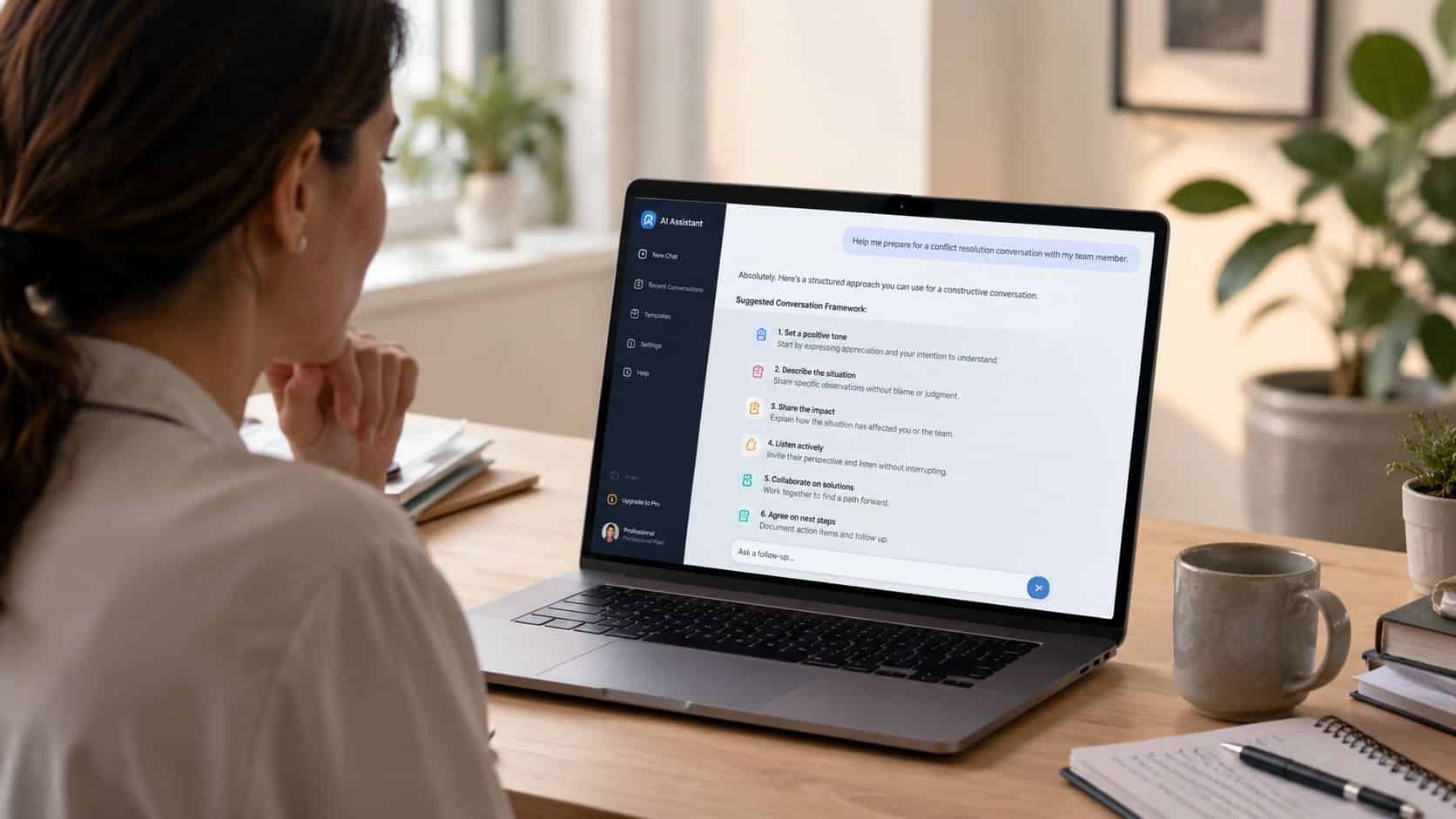
AI is most useful on either side of the live conversation, not during it. Before, it helps you prepare. After, it helps you document and follow through. The middle, the part where two people are actually in the room, is yours alone. A useful way to think about it: get clearer before the meeting, more disciplined after it, and never use it to avoid the meeting itself.
Where AI Earns Its Keep
Before a mediation, you can turn messy one-on-one notes into a clean, neutral opening statement, separate facts from interpretations in your own read of the situation, and spot recurring triggers across past meetings, like repeated interruptions or the same ownership dispute resurfacing. A full prompt to prepare:
Act as a people manager preparing to mediate a conflict between two direct reports.

The two people: [names/roles, and how long they’ve worked together]
What I’ve observed: [specific incidents, dates, what each person did]
What each one says the problem is: [person A’s version, person B’s version]
What it’s costing the team: [missed deadlines, rework, side-taking, etc.]
Conflict type I suspect: [scope, credit, workload, style clash, normalized behavior, or performance-in-disguise]

Draft a neutral opening statement for a joint conversation. List the likely root issues. Tell me what needs private coaching versus joint discussion. Produce a follow-up template focused on behavior, ownership, and a review date. Don’t make legal judgments, and flag anything that looks like it should go to HR instead.
After the conversation, it’s strong at the documentation most managers skip when they’re drained: a summary with commitments and deadlines, a checklist for the next check-in, loaded language rewritten into behavioral language. A full prompt for the analysis pass:
Analyze the material below from a conflict between two team members.

Slack excerpts / meeting notes: [paste the raw text]
Background I have: [anything relevant about history, roles, prior coaching]

Separate the conflict into four categories: scope, communication style, decision rights, and performance concerns. For each, note which person it centers on and what evidence supports it. Flag anything that should go to HR instead of mediation. Rewrite any loaded or accusatory language you find into neutral, behavioral terms I could actually use in a conversation.
For a repeatable workflow, how to start using AI as a manager treats the tool as a practical assistant rather than a fix for weak judgment.
Where AI Can’t Help
AI can’t watch two people walk into a room and notice one is already shut down. It can’t hear the silence after a loaded comment or read the team history behind it. It can’t tell whether someone is being evasive, scared, manipulative, or just overwhelmed.
| AI can help with | AI can’t do |
|---|---|
| Drafting neutral language | Reading body language |
| Finding patterns in notes | Assessing credibility in real time |
| Writing summaries and follow-ups | Understanding team politics |
| Rehearsing the conversation | Deciding who needs to grow, move, or leave |
| Creating documentation | Replacing your judgment |
One more thing, and it’s not optional. Be careful with privacy. Sensitive employee details shouldn’t be pasted casually into AI tools. Use approved tools, strip identifying specifics where you can, and know your company’s rules before any of this touches a real person’s record.
Prevent the Next One
A conflict is only resolved when the team stops paying for it, and that usually takes more than one conversation. Document the agreement, set a review date, and actually track whether behavior changed, because the follow-through is where most managers quietly let resolutions die under delivery pressure.
The bigger lesson is often systemic. Conflict isn’t always a people problem; it frequently starts as a process problem, especially on remote and hybrid teams where vague ownership and unclear handoffs manufacture friction, a pattern AIHR documents in its work on workplace conflict. If two people fought over approvals, your decision rights need tightening. If they fought over responsiveness, your channel norms need to be explicit. If one person kept colliding with others because they genuinely lacked a core skill, the answer might be a real employee development plan rather than another vague “communicate better” talk.
You don’t need to eliminate conflict. You need to prevent the stupid kind, surface the useful kind early, and act decisively when conflict turns out to be a mask for misconduct, weak performance, or poor team design. Resolution should leave behind a better system, not just a quieter room.
Frequently Asked Questions
When should a manager step into peer conflict?
The moment the tension starts changing how the rest of the team communicates. If two people are merely disagreeing but still working professionally, light structure is enough. Once output, trust, or team behavior bends around the conflict, it’s yours to handle.
What are the main ways to resolve conflict between two employees?
Five, from lightest to heaviest: let them work it out with light structure, coach one or both privately, mediate a direct conversation, escalate to HR, or recognize that someone needs to leave. The skill is choosing the smallest one that actually works.
When should conflict go to HR instead of mediation?
When it stops being routine friction. Harassment or protected-category concerns, threats or intimidation, repeated misconduct after clear coaching, a power imbalance that prevents honest participation, or dishonesty all belong in a formal process, not a “let’s talk it through” conversation.
Can AI resolve workplace conflict?
No, and it shouldn’t try. AI is useful before and after the conversation, drafting neutral language, spotting patterns in your notes, writing follow-ups. It can’t read the room, judge credibility, or decide who needs to grow, move, or leave. That judgment stays with you.