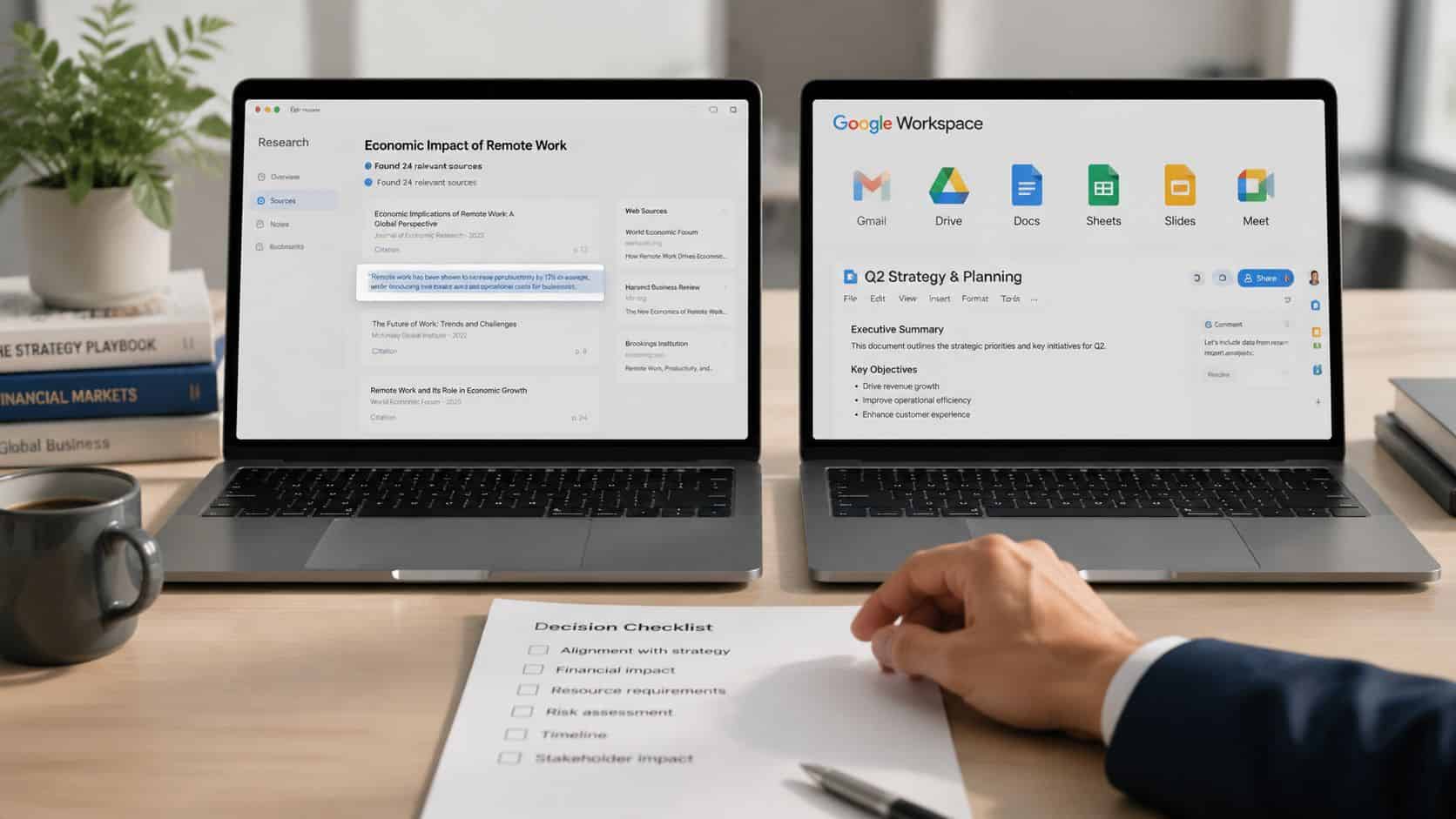
The Perplexity vs Gemini question arrives with a detail most comparisons skip. If your company runs Google Workspace, you may already be paying for one of the contestants. Gemini’s work features come bundled into Business Standard plans and above, sitting inside the Gmail, Docs, and Drive your team lives in, whether anyone has switched them on or not. That changes the shape of the decision entirely. This stops being a feature bake-off and becomes a purchasing question. Is the research you already own good enough, or does evidence someone can check justify a second subscription?
The honest answer runs on one split. Gemini’s strength is everything inside your walls, meaning the answer that’s buried in Drive, the thread in Gmail, the synthesis that has to become a document by noon. Perplexity’s strength is everything outside them, meaning the market scan, the policy lookup, the competitor brief where a skeptical reader will ask where each claim came from, and every answer arrives with its sources showing.
So this comparison works like an audit rather than a scorecard. Where your research actually lives, which of four manager jobs each tool wins, the paired workflow that uses both without paying twice for the same answer, and the one-minute checklist that settles the second-seat question for your specific week.
Key Takeaways
- Perplexity vs Gemini is mostly a question about a second subscription, because if your company runs Google Workspace you are probably already paying for Gemini.
- Audit a real week of your own questions before deciding. The overlap between the two is larger than the marketing suggests, and your actual usage settles it.
- Split the research jobs: Gemini wins on anything already inside your Drive, Gmail, and Docs; Perplexity wins on open-web scans where you need sources you can check.
- Two jobs stay genuinely contested, and those are the ones worth testing yourself rather than taking anyone’s word on.
- If you keep both, set clear boundaries so they do not collide: one tool for internal files, one for the open web, and a paired workflow with prompts for each.
Table of Contents
The Overlap, and the Audit That Finds It
Start with what’s already in the building. Google’s own product pages confirm Gemini comes included with Workspace plans, working across Gmail, Drive, Docs, Sheets, Slides, and Chat, and its research mode reaches across those same apps, with Google’s Deep Research documentation describing runs that pull from your mail, files, and conversations alongside the web. A Google-shop manager owns real research capability before spending anything, and most haven’t tested where its edges are. The full Gemini review walks that day-to-day.
Perplexity comes at research from the opposite door. It’s a standalone engine built around one promise, that every claim in its answers arrives with a source you can open. Ask it a question and it searches live, compares what it finds, and hands back a brief with the trail showing. The Perplexity guide for managers covers when that’s worth twenty dollars a month, and the short version is that it depends entirely on how often your work has to survive the question “where did this come from?”
| Perplexity | Gemini | |
|---|---|---|
| Built around | Research with the sources showing | Your Google stack, with research included |
| Knows about | The public web, live | Your files, mail, and chats, plus the web |
| Best question | What supports this claim? | What do our documents say, and what’s next? |
| Strongest output | A brief a skeptic can check | A draft, agenda, or summary inside Workspace |
| Weak spot | Doesn’t know your company | Sources take a back seat in everyday drafting |
| The buyer | The research-heavy manager | Anyone already paying for Workspace |
Audit a week of real questions
Before buying anything, pull up the last two weeks of research-shaped work and sort each request into one of four piles. Finding something the company already knows, like a decision in Drive or a commitment in Gmail. Turning internal material into a document, like notes becoming a review draft or a brief. Finding something outside the company, like competitor moves, market rates, or a policy change. And building an answer someone will challenge, where the major claims need evidence attached.
The first two piles are Gemini’s home turf, and no standalone tool will beat working where the material already lives. The second two build the case for Perplexity, growing stronger the more often they recur. Most managers who run this audit find their split is lopsided in one direction, and the lopsidedness is the answer. A team that rarely leaves its own documents has no second-seat problem to solve, while a team preparing external briefs every week has one whether it’s been named or not.
Four Research Jobs, Scored Honestly
Benchmarks won’t settle this for you. Independent comparisons consistently rate Perplexity’s citation reliability highly, and even those write-ups add the caveat that matters more than the scores, which is that a citation can exist without fully supporting the sentence it’s attached to. Open the sources that carry weight. What the tools actually win on is fit to the job, so here are the four that fill a manager’s research time.
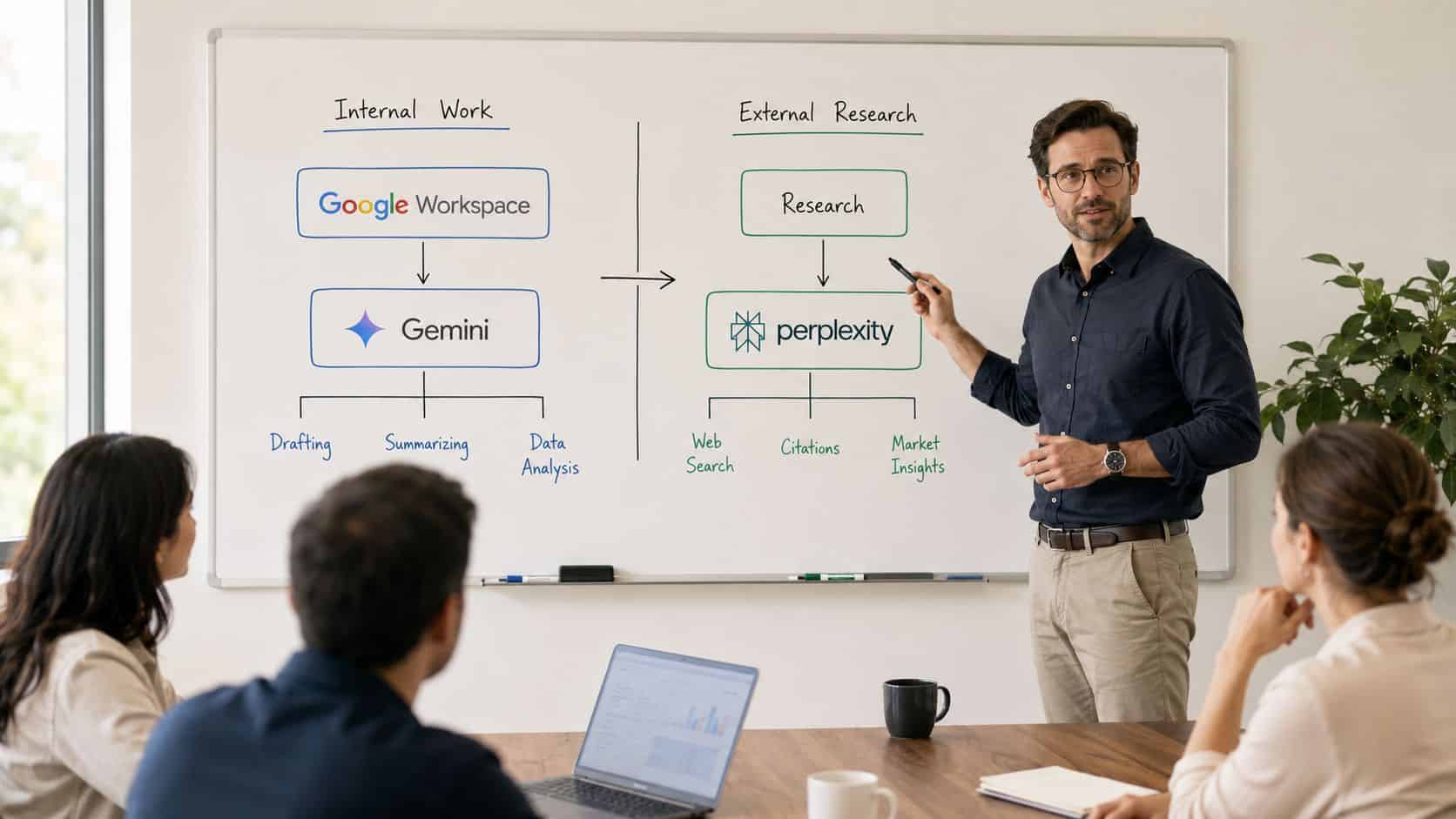
| Research job | The edge | Why |
|---|---|---|
| Market and competitor scans | Perplexity, for anything you’ll forward | Live sources, visible trail, easy to check |
| Policy and compliance lookups | Perplexity outside, Gemini inside | Public rules need the trail; your own policy lives in Drive |
| Hiring-market research | Perplexity first, Gemini second | Pay ranges and role norms are outside work; scorecards are inside work |
| Briefings and syntheses | Follows the destination | Leaving the company, cite it; staying in Docs, keep it native |
The two that stay contested
Market research is the closest call, because Gemini’s research mode produces genuinely serious external briefs, and if the output’s next stop is a Google Doc for an internal audience, staying native saves the copying and reshaping. The tiebreaker is the audience. Forwarding it upward or outward, where someone will probe the claims, favors the tool whose sources ride along. If your everyday assistant is ChatGPT rather than Gemini, the same research-versus-generalist boundary gets mapped in the Perplexity vs ChatGPT comparison, and the logic transfers.
Briefings split on the same line, with one addition. When the research has to become genuinely careful writing, a board memo, a sensitive recommendation, the strongest pipeline runs the evidence through Perplexity and hands the drafting to a writing specialist, the pattern the Perplexity vs Claude comparison builds out in full. Gemini can run the whole path alone inside a Google shop, and for routine briefs it should. The specialist pipeline is for the documents where the writing itself carries risk.
The Paired Workflow, With Prompts
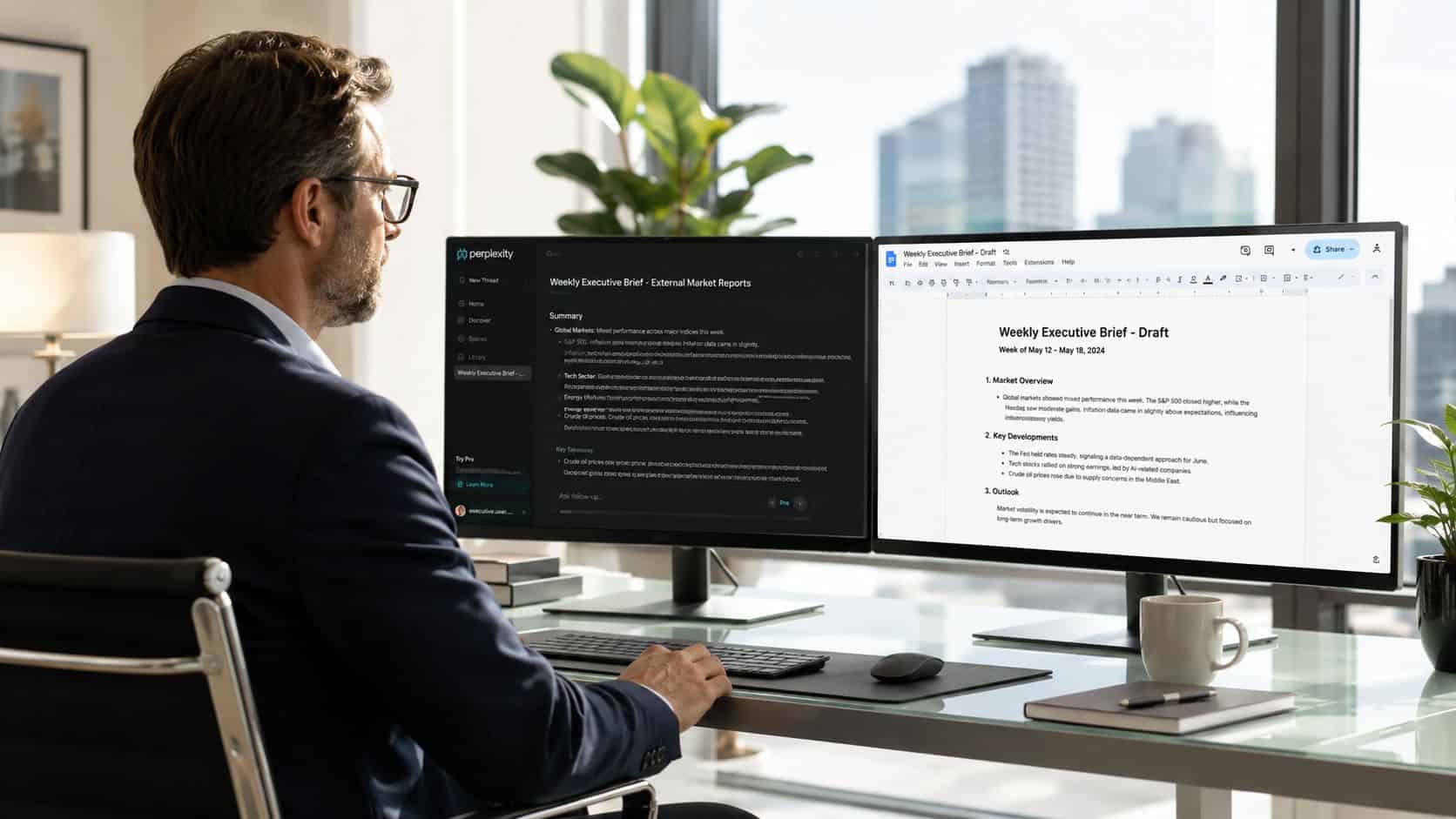
The tools stop competing the moment each has a lane, and the weekly leadership meeting shows the pairing at its best. Perplexity gathers what changed outside, then Gemini reads what’s unresolved inside, and neither does the other’s job.
External scan (Perplexity):
Summarize developments from the last seven days affecting our industry. Cite a source for each item, separate what happened from what commentators think it means, and end with a short list of decisions a leadership team might need to make because of it.Internal synthesis (Gemini):
Using the connected agenda, status documents, and meeting notes, identify unresolved decisions, items with conflicting owners, and risks nobody has claimed. Produce a one-page agenda and a short follow-up email draft. Use only the connected documents for internal facts, and flag anything where the evidence is missing.Performance review season runs the same split with the weight reversed. Gemini holds the advantage because the goals, feedback, and prior reviews already live in Drive, and a narrow instruction keeps it honest.
Review evidence (Gemini):
Using only the goals, documented outcomes, and feedback in these files, identify observable achievements, development areas, and gaps where the evidence is thin. Do not infer personality or intent.That last sentence is the guardrail. A model handed a quarter of notes will happily turn tone, silence, or one stray comment into a theory about a person, and the instruction shuts the door before it opens. Perplexity’s review-season role stays outside the building, researching calibration practices or market context, never touching individual employee material.
Compensation research deserves its own prompt, because it’s where unchecked AI output does the most quiet damage.
Compensation scan (Perplexity):
Compare current base-pay and equity ranges for this role from credible sources. For each source, note the location, seniority level, methodology, and how recent the data is. Flag where sources disagree, and link everything.Then read the methodology notes before trusting the table, because a polished range built from a broad national survey can miss your local market by a full band, and the manager who approves it owns the miss. The tool finds the sources. Judging whether they apply to your team stays your job.
The boundaries that keep it clean
Confidential employee, candidate, and pay material stays in the systems your company already governs, and neither tool should receive it just because pasting is convenient. Connect Gemini to Workspace only after an admin has looked at permissions and retention, and treat every other integration the same way, since connecting a stack responsibly is a governance decision before it’s a convenience one. And when comparing plans and capabilities, current evaluation guides like this one on cost, speed, and safety are useful context, with the standing caveat that tool details move fast enough to check against the vendors’ own pages before buying.
The Money, Settled in One Minute
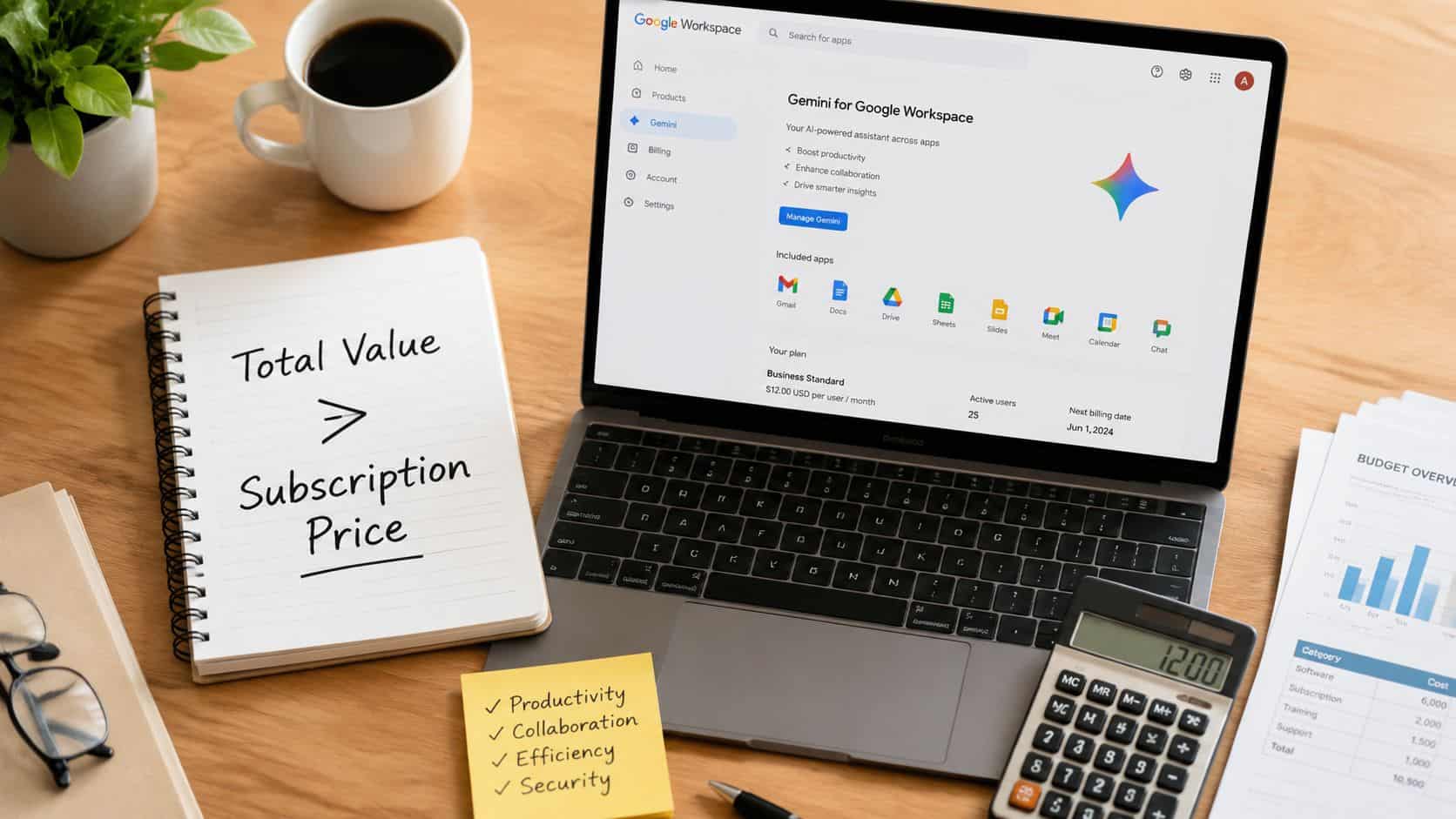
The subscription math is friendlier than most comparisons pretend. Gemini’s work features ride along in eligible Workspace plans, with a standalone tier around twenty dollars for individuals, and Perplexity Pro runs the same twenty. The real cost was never the sticker. It’s paying for research capability twice, and the checklist below catches that in a minute.
- Does the company already pay for a Workspace plan that includes Gemini? If yes, it goes first, and it might be enough.
- Where did last month’s research actually live, in Drive and Gmail, or on the public web?
- Will leadership, finance, or legal ask where the claims came from? Recurring yes means the citation engine earns its seat.
- Does external research happen weekly, or a few times a quarter? Occasional needs don’t justify a dedicated subscription.
- Does the output become a Google Doc and a follow-up, or a brief that leaves the building?
Buying both for everyone fails the audit almost every time. The pattern that works is Gemini as the floor for every Google-shop manager, with Perplexity assigned to the specific roles whose weeks contain the recurring external-evidence problem. One tool by default, two tools by demonstrated need, zero tools doing a job the other already covers.
The Verdict
Pick Gemini first when the company runs Google Workspace and the week’s research mostly means finding, combining, and drafting from what the team already knows. It’s already in the seat price, it works where the documents live, and for light external research its built-in mode covers more ground than most managers have tested. If the suite question itself is still open, the Copilot vs Gemini comparison covers the Microsoft side of that fork, and ChatGPT vs Gemini covers whether a standalone generalist belongs on top.
Pick Perplexity first when the research is external, recurring, and headed for skeptical readers. Market intelligence, policy work, competitor briefs, and hiring-market scans with the sources showing are its lane, and no bundled assistant matches the checkability. It joins a stack rather than replacing one, which is the point. And for the manager weighing this choice inside the full five-tool picture, the assistant decision framework places both tools on the larger map.
One line to carry out. Gemini acts on what the company already knows, Perplexity proves what the outside world is saying, and a manager who routes by that split never pays twice for the same answer.
Frequently Asked Questions
Is Perplexity better than Gemini?
For live external research where every claim needs a checkable source, yes. For work built on your company’s own documents inside Google Workspace, no. They’re strongest in different places, and the practical question is where your research actually lives. Mostly inside Drive and Gmail points to Gemini, and mostly on the public web with skeptical readers points to Perplexity.
Is Gemini free if my company uses Google Workspace?
For most current business plans, its work features are included rather than separately billed. Google bundles Gemini into Workspace Business Standard and above, working across Gmail, Docs, Drive, and Meet, so check which plan your company runs before paying for anything standalone. Individual plans outside Workspace run around twenty dollars a month.
Does Gemini cite sources like Perplexity does?
In its research modes, yes, though citations sit less centrally in its everyday answers than in Perplexity’s, where every response is built around the source trail. For internal drafting the difference rarely matters. For external claims a stakeholder might challenge, Perplexity’s citation-first design makes checking faster and forwarding safer.
Should a manager use both Perplexity and Gemini?
Only when the audit shows both jobs recurring, meaning real internal synthesis work and real external evidence work, week after week. The pairing runs cleanly, with Perplexity gathering cited outside research and Gemini turning approved findings into documents where the team works. Start with whichever tool the company already pays for, and add the second only for the roles with a demonstrated gap.