
The after-action review has a reputation problem it doesn’t deserve. The format gets treated as military ceremony or consulting theater, when it’s actually the shortest reliable path between a project ending and a team learning something. The failure was never the four questions. It’s what surrounds them, reviews scheduled weeks too late, blamelessness so careful it names nothing, and beautiful documents that change no behavior. The AAR fixes the structure. The manager fixes the honesty and the follow-through, and this guide is about that second half.
The method here is deliberately small. Four questions in a fixed order, a 30-minute run sheet, a facilitator script for the moments where reviews usually die, and a closure cadence that treats the meeting as the easy part. AI carries the clerical weight, building the pre-read from scattered evidence and turning notes into trackable commitments, while the judgment calls stay human where they belong.
Run it on the next contained project event, success or failure, and refuse to close the meeting until every change has one owner and one place it gets checked. That last sentence is most of the method. Everything below is how to make it stick.
Key Takeaways
- Run the after-action review while people still remember, ideally within days, because a review held weeks later collects tidy stories instead of the truth.
- Use four questions in order: what we expected, what actually happened, why the gap, and what we change. The order is what keeps it from drifting into blame.
- Blamelessness that names nothing teaches nothing. Name the moment and the decision, not the person, so the review still produces a usable cause.
- Thirty minutes is enough. A tight run sheet beats a beautiful document nobody reads, and the write-up should fit on one page.
- The learning happens when you close the loop: one accountable owner per change, a date, and a check that the change actually held.
Table of Contents
Why Most Post-Mortems Fail Before They Start
Three failure modes account for nearly every wasted review, and all three are decisions the manager controls.
Too late to remember anything true
A review scheduled weeks after a project ends is already compromised. People have forgotten the order things happened in, the pressure they were under, and the assumptions that seemed reasonable at the time, so the conversation drifts toward the final outcome, the loudest memory, or whatever evidence sits nearest the top of the project folder. The fix is calendar discipline. Hold the review within 72 hours of the event ending, while the timeline still lives in people’s heads instead of their revisions of it.
Blamelessness so careful it names nothing
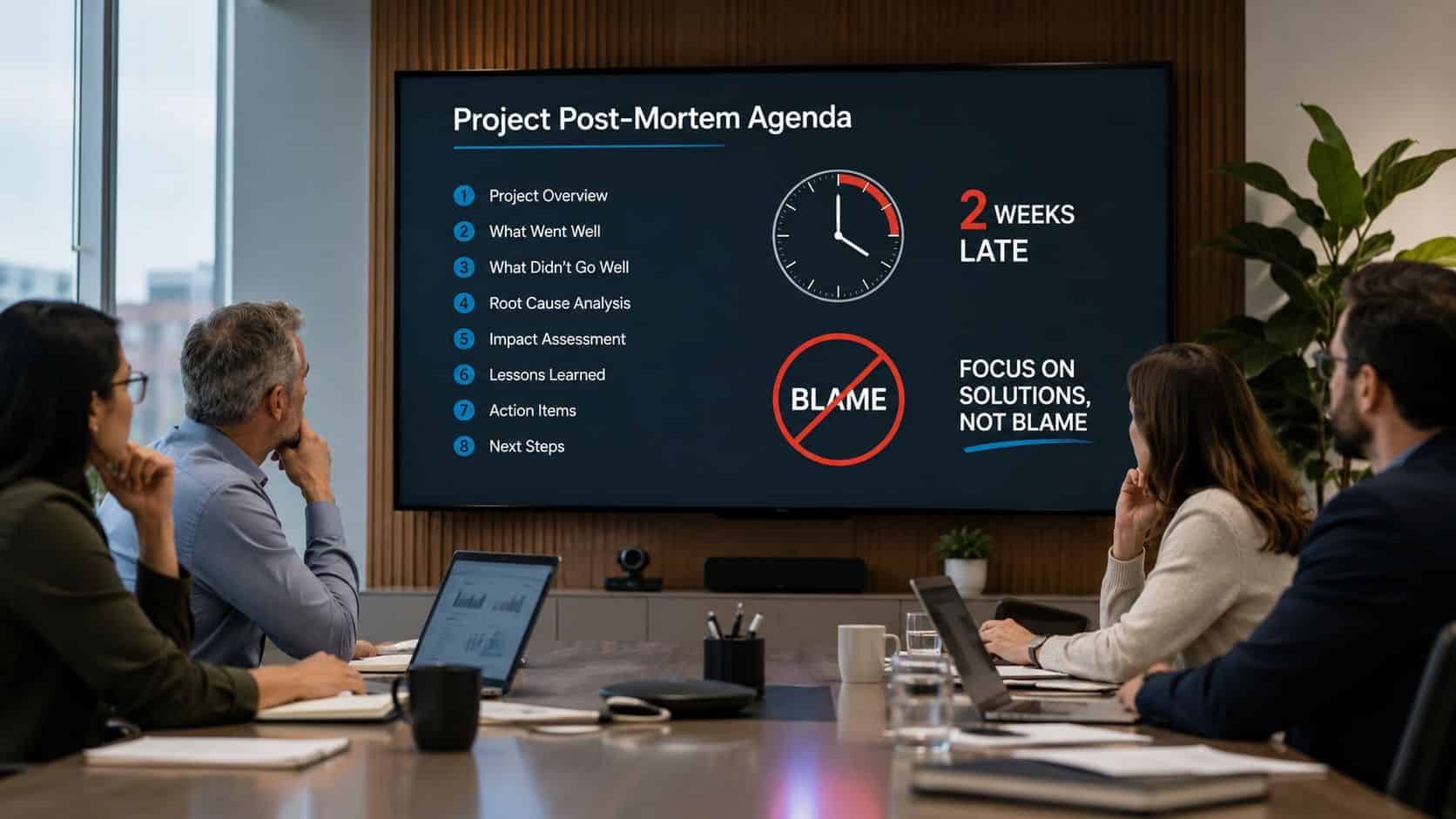
The second failure hides inside a virtue. Managers announce the review is “blameless,” then steer around the specific decision, handoff, or missed warning that created the problem. What’s left is sanitized ambiguity wearing psychological safety’s name. A useful review protects people from personal attack while still looking hard at the choices that were made, and holding both at once is a facilitation skill rather than a ground rule. The script for it comes in the next section.
The beautiful document
The third failure looks like success. Someone turns messy notes into a handsome report, circulates it, and assumes the organization learned something. The research on lessons-learned processes says otherwise. The recurring gap sits between lessons being noticed and lessons being checked, kept findable, and actually put into practice, which is why reviews of lessons-learned methods emphasize the work after the meeting over the document itself. If nobody checks whether the change occurred, the organization hasn’t learned. It has produced an articulate record of being surprised.
The mental model that survives all three failures runs capture, confirm, share, and track. And when the learning has to travel across team boundaries rather than staying with the people in the room, a defined way of moving work between teams matters more than a better archive, because cross-team lessons die in handoffs, not folders.
The Four Questions, in the Order That Matters
The AAR runs on four questions asked in a fixed sequence, and the sequence is the point. Shared facts come first, explanations second, decisions last. Reverse it and the meeting becomes a debate about conclusions nobody has earned yet.
What was supposed to happen? The team describes the intended outcome, the timeline, and what everyone assumed going in. “What did the plan require from each function?” beats “what was the goal?” because it surfaces who was depending on whom while everyone is still calm.
What happened? Build the timeline everyone can see. Ask what customers, stakeholders, systems, and the team experienced instead, and keep facts separate from opinions about facts. Tickets, thread history, meeting notes, and delivery dates let the group test memory without the meeting turning into a courtroom.
Why was there a difference? The question facilitation protects. Ask what people knew, what they didn’t, what constraint or handoff failed, and where nobody was clearly in charge. “Why didn’t Alex flag this?” is weaker than “what made the risk hard to flag, and what would have made speaking up easier?” The second version finds the same fact and keeps Alex in the conversation.
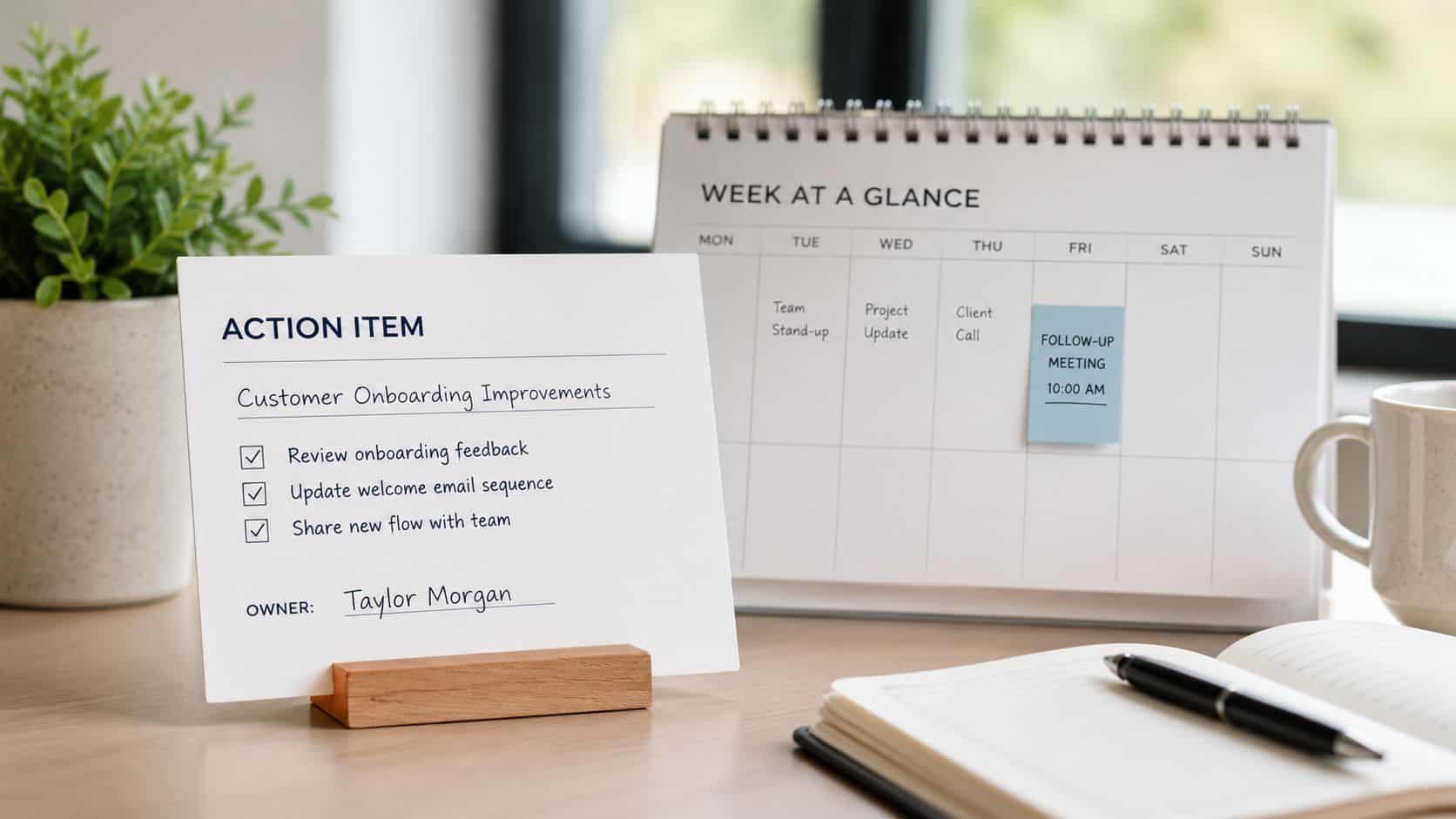
What should change next time? Require a specific change to how someone works, what gets written down, or who gets to make the call. “We should communicate better” doesn’t survive contact with a calendar. “The release owner posts a risk summary in the launch channel before approval” can be tested, and testable is the bar.
The ground rules, and why they hold
State the purpose before the first question. Learning, never punishment. Direct knowledge over hearsay. Decisions examined without people attacked. That framing is engineering rather than softness, and the evidence behind it is real. Amy Edmondson’s study of 51 work teams tied psychological safety to learning behavior, and learning behavior to performance, which is the entire chain an AAR is betting on. A team that doesn’t feel safe gives you the sanitized version, and the sanitized version teaches nothing.
The opening script, verbatim:
This is a learning review, not a disciplinary investigation. We’ll compare what was expected with what occurred, examine the reasons for the difference, and agree on changes for future work. Speak plainly, challenge assumptions, and discuss systems and decisions without attacking people. I’ll speak last on the change questions so the analysis isn’t anchored by my read.
The manager-speaks-last rule at the end is the move most managers skip and the one that matters most. Speak first on “what should change” and the team’s analysis converges on yours within two sentences; authority anchors faster than any argument. Say the rule out loud at the start and it also becomes a small public commitment your team will notice you keeping. The invite, pre-read request, and question sequence can all come off the meeting agenda prompts with minor adaptation.
The 30-Minute Run Sheet
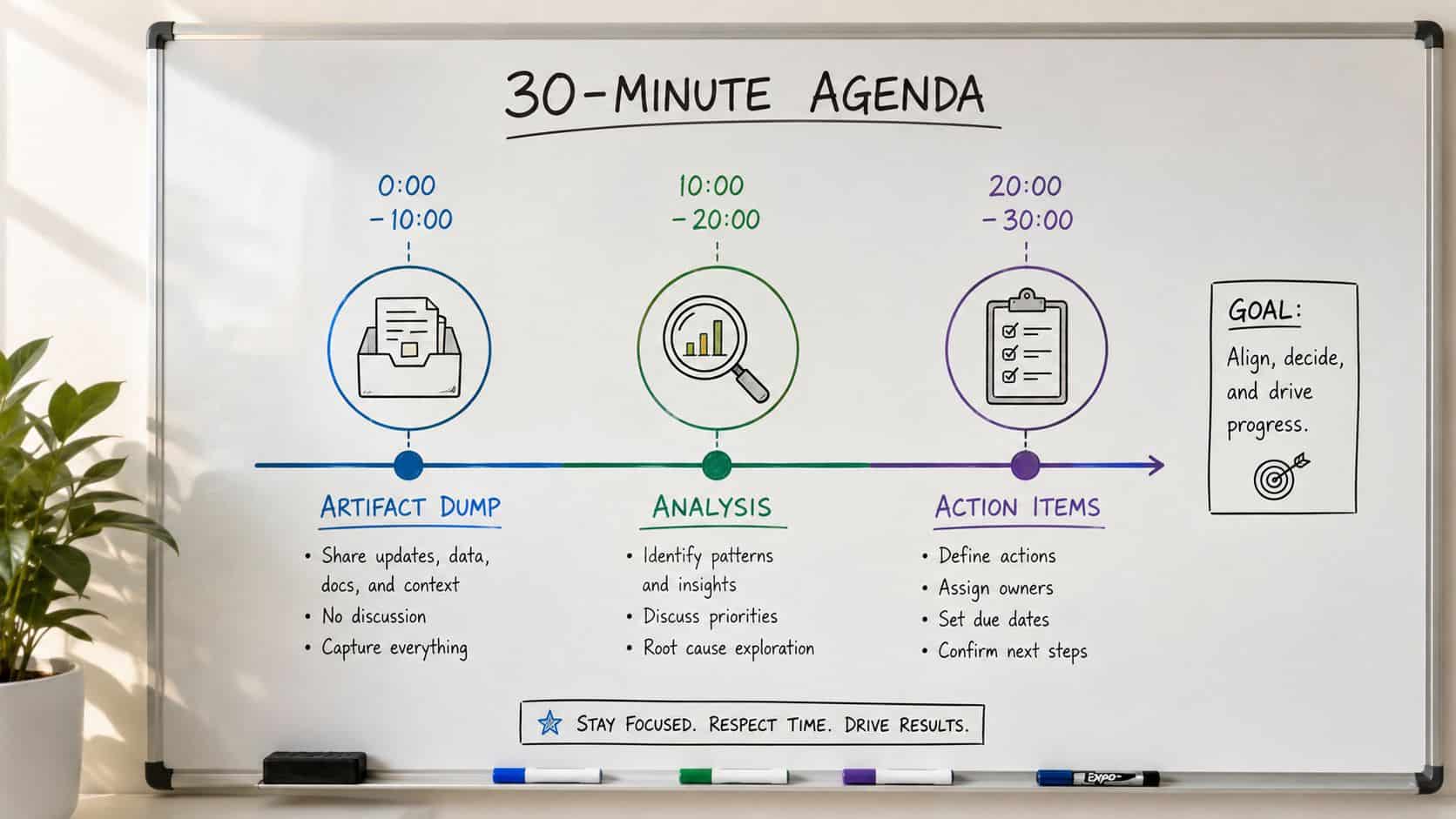
Thirty minutes covers a contained event. It doesn’t cover a complex cross-functional failure, a regulated incident, or a dispute over what the data even says, and forcing those into a half hour produces a fast meeting about the wrong thing. Use a longer review or a separate investigation when the event exceeds the team’s ability to establish shared facts quickly.
Invite the people who did the work, and add a cross-functional partner when the failure happened at a boundary. A manager who invites only leaders gets a leadership narrative, which is usually the least complete version available.
| Minutes | Phase | What happens |
|---|---|---|
| 0 to 5 | Evidence goes up | Put up the plan, the key tickets, the thread where it went sideways, and what actually shipped. People add missing facts without debating causes yet |
| 5 to 10 | What was supposed to happen | Confirm what done looked like, what order things had to happen in, who handed off to whom, and who could say yes |
| 10 to 16 | What happened | Build the timeline. The facilitator records the visible differences and parks disputed details for checking later |
| 16 to 23 | Why the difference | Dig into what people assumed, what they didn’t know, and where nobody was clearly in charge |
| 23 to 27 | Changes | Each person offers one change worth testing. The manager speaks last |
| 27 to 30 | Commitments | Every change gets one owner, a date, how you’ll know it worked, and where you’ll check |
Run the session from a shared surface where the evidence stays visible, whether that’s a whiteboard or a screen with four labeled sections. A slide deck makes the manager the narrator, and narrated reviews produce audiences instead of participants.
End with one or a few meaningful changes. A group that identifies ten priorities has avoided prioritizing, and the unresolved questions belong in a separate investigation rather than a longer action list.
Two Reviews That Went Wrong, and the Moves That Fix Them
The blame spiral
The first review concerned a delayed launch. The product manager opened by asking why engineering had missed the date. Engineering replied that requirements had changed. Marketing pointed to late approvals. The manager tried to restore order by asking everyone to be professional, which only made the accusations quieter.
The missed move was visible in real time. The question needed to shift from who caused the delay to which decision and handoff let the schedule stay unrealistic, and the facilitator owns that shift. The intervention, verbatim:
Pause. The current wording assigns fault. Let’s name the moment when the plan stopped matching reality, then figure out what should have told us to change the plan, and who could have called it.
Two sentences, and the meeting has a different subject. The other discipline in this failure mode is capping repeated speeches. Once a point has been made with evidence, the next person restating it with stronger adjectives adds heat without information. Capture the point, ask who has contrary evidence, and move. The redirection pattern is the same one that runs through conflict resolution done well, acknowledging the concern, restating the shared problem, and steering from accusation toward the next specific decision.
The beautiful document
The second review had the opposite problem. Calm, inclusive, impressively documented. The team identified unclear approval ownership, inconsistent customer escalation, and an overloaded release checklist, and the final page looked excellent. Three weeks later no checklist had changed, no approval rule had an owner, and nobody could say whether the escalation path had been tested.
The failure happened in minute 26, when the facilitator accepted “we should communicate better” as an action item. That phrase is a hiding place for inaction, and the correction costs one question. Who will change which document or behavior, by when, and how will the team know it worked? If the answer is everyone, there’s no owner. If the answer is soon, there’s no commitment. A review earns its calm by being disciplined about exactly this, because comfort was never the goal. Safe enough for accurate information, disciplined enough to produce a change.
Closing the Loop, Where the Actual Learning Happens
The meeting is the easy part. The hard part starts when everyone goes back to their calendars and their backlogs, and whether anything changes now depends entirely on what the manager does in the next few days.
Within a day, turn the notes into a short record and send it to the people who were in the room. You’re asking one question. Does this accurately capture what we saw, why we think it happened, and what we agreed to change? If an owner disputes the wording or the feasibility, better to fix the commitment now than to track a task nobody believes in. The meeting minutes discipline covers the record format, and the AAR version just adds the why and the changes on top of the factual timeline.
Store the approved record wherever your team already looks things up, with enough labels that someone can find it next quarter. A lesson filed in a private folder is a lesson the next team gets to relearn the hard way, and the basics of keeping team knowledge findable matter more than which tool does the storing.
Then the cadence, which is where most reviews quietly die.
1. Next working day, confirm the record and turn each change into a task someone can see.
2. Every Monday, check last week’s commitments. Ask owners what changed, what’s stuck, and what proof exists.
3. During the week, nudge with specifics. “Did the risk summary go in the launch channel?” beats “don’t forget our lessons learned.”
4. At the next launch or incident, check whether the new behavior actually got used. That’s the moment a lesson becomes real to the team.
5. At the next review, look at closure before new problems. Unfinished items stay visible until someone finishes them, changes them, or openly retires them.
The record also feeds upward without extra work. Closed changes belong in your weekly status updates as evidence the team learns, and the sharper project update is the one that names what changed since the last stumble rather than restating the plan.
AI Prompts for the Whole Workflow
AI belongs in this process as the clerk, never the judge. It can pull scattered evidence into a pre-read, turn messy notes into a clean record, and draft the follow-up nudges, and it can’t decide whether someone’s account is accurate or whether a change is safe to make. Keep that line and the tools save real hours.
Before the meeting
Give the assistant the project plan, the relevant threads, the tickets, and any transcripts, minus whatever your company’s AI policy says stays out.
Pre-read prompt:
You're preparing a factual pre-read for an after-action review. Using only what I've supplied, create four sections. What was supposed to happen, what actually happened, the visible differences, and the open questions. Keep evidence separate from interpretation, don't assign blame, note where each claim came from, and flag contradictions instead of resolving them. Keep it short enough to read before the meeting.Which assistant does this best depends on the mess. Claude handles long, uneven material with competing accounts more gracefully, while ChatGPT is the faster draft partner for the invite and question sequence, the same split the ChatGPT vs Claude comparison maps in full. If the meeting itself needs capturing, the note taker rankings cover that layer, consent script included.
After the meeting
Record prompt:
Turn these discussion notes into an after-action record with sections for what was expected, what happened, why they differed, the changes we agreed to, who owns each one, the date, and how we'll know it worked. Keep the uncertainty visible. Don't invent owners, dates, or decisions, and mark any change that's too vague to track.Then read every line before it ships, because AI’s most dangerous habit here is making vague language look finished, and this is an accountability document.
Nudge prompt:
Write a short message to an action owner. State the change we agreed, the due date, what evidence we expected, and one direct question about anything blocking them. Factual and supportive, and don't imply it's done without proof.The Pitfalls, and the One-Line Fixes
- The loudest voice writes the history. Fix it with two minutes of silent note-taking first, then a round that reaches the quiet people before open debate.
- “Improve communication” makes the action list. Fix it by requiring a change someone could observe, with a name and a date attached.
- The change belongs to “the team.” Fix it with one accountable person, however many people will help.
- The document gets filed and never checked. Fix it with the Monday look at open commitments, kept up until items close.
- Reviews only happen after failures. Fix it by reviewing wins on the same cadence, because a team that only meets to autopsy learns to dread the room.
The method doesn’t promise clean execution. It promises a repeatable way to notice gaps, tell the truth about them, and make one person responsible for the next improvement. Start with the next contained event, and hold the last three minutes hostage until every change has its owner.
Frequently Asked Questions
What are the four questions in an after-action review?
In order, what was supposed to happen, what actually happened, why there was a difference, and what should change next time. The sequence matters because it moves the group from shared facts to explanation before anyone proposes fixes, which keeps the meeting from becoming a debate about conclusions nobody has earned yet.
How long should an after-action review take?
Thirty minutes for a contained event, following a tight run sheet from evidence to commitments. Complex cross-functional failures, regulated incidents, and anything where the basic facts are disputed need a longer review or a separate investigation, and squeezing them into half an hour produces a fast meeting about the wrong thing.
What’s the difference between an AAR, a post-mortem, and a retrospective?
Mostly heritage and habit. The AAR comes from the military and centers four fixed questions, post-mortems come from engineering culture and often focus on incidents, and retrospectives come from agile and run on a recurring cadence. The format matters less than the disciplines they share when done well, which are prompt timing, honest analysis of decisions rather than people, and tracked follow-through.
How soon after a project should you run the review?
Within about 72 hours of the event ending. Memory of what people assumed, what pressure they were under, and what order things happened in degrades fast, and a review held weeks later tends to relitigate the outcome instead of examining the decisions. Book the review when you book the launch.