
Every performance review phrases listicle promises a hundred copy-paste lines, and every employee can tell when they received one. “Shows initiative,” “great team player,” and “strong communicator” have appeared in enough reviews, templates, and LinkedIn carousels that they now trigger suspicion before appreciation.
Phrases are calibration material rather than final copy. The sentence you submit should contain something only you could know: a dated decision, a difficult project, a customer outcome, a missed handoff, or a change that became visible over the cycle. Generic wording gives you somewhere to start. It doesn’t give an employee a reason to believe the review was written for them.
That distinction matters more now that most managers use an AI assistant to collect and summarize the year. These tools organize evidence well, and they can’t supply observations that were never recorded. The workflow that works is the same as it always was, with a faster middle step. Gather real notes, choose language that matches the situation, then edit every sentence until it sounds natural in a one-on-one.
Key Takeaways
- Performance review phrases are raw material, not finished comments, and employees notice immediately when a phrase was pasted rather than written.
- Any phrase lands when it names the behavior, attaches the context, explains the effect, and drops the intensifiers.
- Five situations cover most cycles: the strong performer, the solid-but-stuck contributor, the underperformer, the new hire, and the mixed year.
- AI works from your dated notes, not from nothing, so give it the evidence and a hard constraint against inventing metrics or quotes.
- Read the finished review aloud before you submit it, because anything you would not say in a one-on-one does not belong in the document.
Why Phrase Lists Stop Working the Moment an Employee Reads Them
The copy-paste promise fails because employees read reviews as evidence of attention. You can call someone a dependable team player, but the employee wants to know which commitment was kept, which teammate was helped, and what changed because of it. If the review doesn’t answer those questions, the wording feels borrowed rather than considered.
That reaction is understandable, because formal appraisal language carries a long institutional history. Most large U.S. employers had adopted formal performance reviews by the end of World War II, and adoption was close to universal by the 1960s, a history documented well by HR Brew. The 1950 Performance Rating Act pushed federal agencies toward standardized terms like outstanding, satisfactory, and unsatisfactory. Phrase libraries still carry that industrial-era inheritance, which is part of why the vocabulary sounds like a form.
What employees actually notice
Employees notice when a review sounds like a form was completed rather than a year was observed. They skim familiar adjectives, distrust broad praise, and often assume you phoned it in. Reusable language isn’t the problem. Shipping the reusable language without attaching it to a person, a context, and a result is the problem.
A useful comparison is the after-action review, where the point is preserving what happened, why it happened, and what should change rather than producing polished commentary. The after-action review guide carries the right mindset for review writing too, which is that evidence comes before interpretation.
The practical rule: if an employee could paste your sentence into a colleague’s review without changing a word, it isn’t finished.
Phrases are raw material
Start with something like “raises the team’s quality bar,” then test whether your evidence supports it. Did they catch a pricing error before a customer saw it? Did they build the review checklist the team now uses? Did their walkthrough recording help another team complete a handoff? Those details turn a phrase into a comment you could defend in a calibration meeting.
This also explains why phrase banks organized only by traits underperform. You’re rarely searching for “initiative” in the abstract. You need language for a strong performer, a reliable contributor who has stopped stretching, a new hire still building context, or someone whose missed commitments need to be described accurately. Choose the situation, pull the vocabulary, attach dated evidence, and rewrite the result in a voice you’d use out loud. The phrase starts the sentence, and your knowledge finishes it.
The Mechanics That Make Any Phrase Land
The mechanics are straightforward, and managers skip them when a deadline is close. A useful comment follows a behavior, context, effect pattern: what the employee did, where or when it happened, and what changed as a result. MIT’s performance review guidance recommends working through accomplishments, obstacles, specific examples, and measurable performance before turning any of it into goals for the next cycle, which is the same order.
Start with behavior
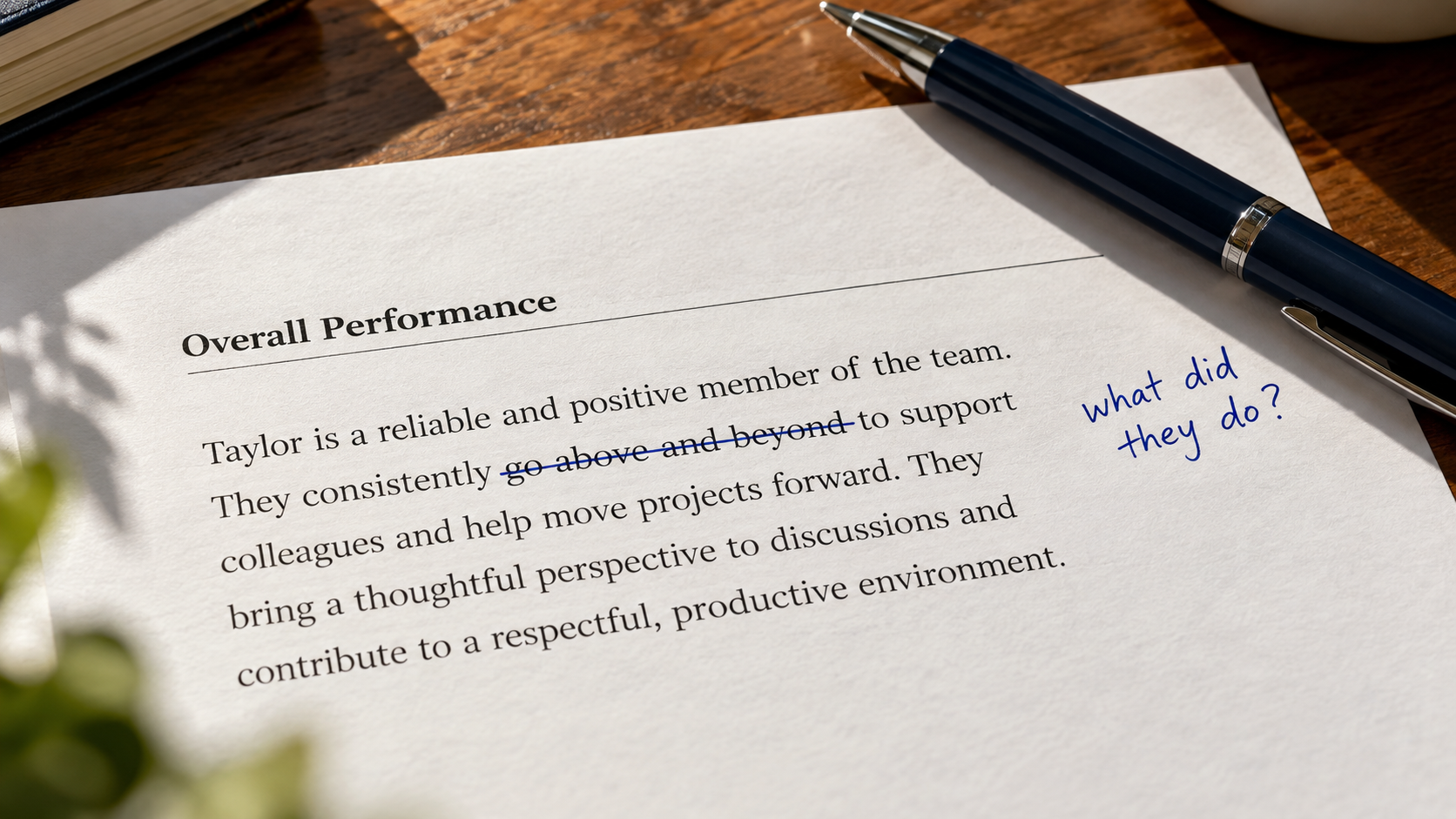
Character labels are weak because they describe a person instead of an action. “Is a hard worker” gives the employee nothing to repeat. “Shipped the customer migration in 11 days while documenting the rollback plan” identifies something that can be recognized and repeated. For the same contributor, the progression looks like this:
- Weak: “Maya is highly proactive.”
- Stronger: “Maya identified the migration risk before the launch review and proposed a rollback plan.”
- Ready to use: “In the March migration review, Maya identified the rollback risk before launch, documented the alternative path, and gave the team a workable decision instead of another open question.”
The final version gives the employee a moment to remember.
Name the context
Context keeps praise from floating free of the work. Name the project, the quarter, the customer, the constraint, or the decision. “Improved communication” is thin. “During the April vendor outage, posted a clear status update and gave Support enough information to answer customers” is anchored to something that happened.
Explain the effect
Impact can be operational, relational, or measurable. Fewer handoff questions, clearer ownership, less rework, a better customer conversation, a decision made earlier. Don’t invent a metric to make a sentence sound stronger. If the effect is qualitative, say so plainly. A good comment lets the employee answer three questions: what happened, why it mattered, and what should continue or change.
Remove intensifiers
Words like consistently, always, and exceptional usually signal filler, especially when no evidence follows. The University of Wisconsin’s writing guide for review comments makes the same recommendation in a sentence: specific behavior, real examples, neutral professional tone, and no extremes like always or never.
A date stamp enforces the discipline. If you can point to a moment, the claim is probably observable. If you can’t recall when it happened, you may be describing a general impression that needs more digging. Before the conversation itself, a set of good review questions is a fast way to test whether a comment opens a useful discussion or closes it.
The Strong Performer and the Solid-but-Stuck Contributor
Two employees can be reliable, well liked, and successful on core responsibilities and still need entirely different language. The strong performer needs recognition for expanded impact and a credible growth edge. The solid-but-stuck contributor needs an honest description of the plateau rather than recycled praise that treats reliability and acceleration as the same thing.
The strong performer
A strong performer has done more than complete assigned work. They’ve hit stretch goals, handled complexity, raised the standard, or made other people more effective. The language should recognize that without collapsing into superlatives.
- Impact: “Delivered the launch while keeping the highest-risk dependencies visible.”
- Collaboration: “Brought Engineering and Support into the decision before the handoff.”
- Growth edge: “The next step is scaling judgment through delegation and coaching.”
A full paragraph might read:
“You delivered the onboarding redesign while the team was also working through a difficult support backlog, and you kept the work moving by surfacing dependency risks early rather than absorbing them silently. The launch plan was clear enough for Engineering and Support to make decisions without waiting for another meeting, and the documentation you created gave the next project a usable starting point. The opportunity now is making that judgment more scalable. Delegating part of the planning and coaching a teammate through the tradeoffs would extend your impact beyond the projects you personally own.”
That recognizes impact, collaboration, and a growth edge without calling anyone exceptional or implying a promotion nobody has approved.
The solid-but-stuck contributor
This one is different. They meet expectations, keep commitments, and may be a stabilizing presence, but the scope of the work hasn’t changed. Calling this person a high-impact leader because you want to sound positive creates a credibility problem, because they know the review doesn’t describe their actual trajectory.
- Name the plateau: “Core delivery is reliable, and the scope of contribution has stayed largely unchanged.”
- Invite expansion: “The next opportunity is owning a problem from definition through follow-through.”
- Development question: “Which broader responsibility would be a meaningful stretch without giving up the work you do well?”
A full paragraph might read:
“You’ve been dependable on the reporting workflow, and stakeholders know they’ll get accurate work when you commit to a date. The next stage of growth is less about doing the current work faster and more about expanding what you own. This cycle the reporting process stayed within the same boundaries, while adjacent questions about data quality and planning stayed with the team lead. Which part of that broader problem would you want to own next, and what support would help you take it from a recurring task to a process you improve?”
The tone stays warm because the work deserves recognition, and it stays direct because the employee deserves an accurate signal.
| Situation | Impact phrase | Collaboration phrase | Growth edge phrase |
|---|---|---|---|
| Strong performer | Delivered a complex launch while keeping risks visible | Connected partner teams before the handoff | Scale judgment through delegation and coaching |
| Solid-but-stuck | Keeps core commitments accurate and predictable | Supports existing workflows without widening ownership | Take responsibility for a broader problem, not only a recurring task |
If you need a shared vocabulary for comparing scope across a team, a benchmarking guide for people teams gives you the frame, and then you apply it to your own evidence rather than importing the labels wholesale. A concrete employee development plan turns the growth edge into an agreed experiment with an owner and a follow-up date.
The Underperformer, the New Hire, and the Mixed Year
The hardest reviews aren’t hard because you lack adjectives. They’re hard because the writing has to be honest, fair, and useful at once, describing what happened without diagnosing personality, overstating certainty, or stepping into decisions HR owns.
The underperformer
Lead with observable gaps tied to outcomes. Missed deadlines, repeated rework, incomplete handoffs, customer complaints, or unaddressed blockers are usable evidence. “Has a poor attitude” is not, and the behavior-first approach matters most in exactly the reviews an employee may challenge.
“Several deliverables this cycle arrived after the agreed date, including the renewal analysis due in May, and the drafts needed additional correction before the team could share them with the customer. The recurring issue has been late escalation when work is at risk, which leaves little time for support or review. The expectation for next cycle is to flag a delivery risk as soon as it becomes visible, use the agreed quality checklist before submission, and review progress in our existing one-on-one cadence. This comment describes the work observed and the support available. Rating, compensation, formal improvement-plan triggers, and employment decisions remain part of the company’s HR process.”
That last sentence keeps the review from becoming a legal document and keeps you from implying authority you may not have. If the conversation goes sideways afterward, the guide on what to do when an employee disagrees with their review covers the follow-through.
The new hire’s first cycle
A first review should describe ramp trajectory rather than pretending the person had a full year of context. Name the onboarding gaps the company owns, like delayed access, thin documentation, or limited exposure to key workflows. Potential can inform development planning without becoming an early promotion signal.
“Your first cycle shows a strong ramp in the core workflow. You moved from needing close guidance on the initial client handoffs to managing routine requests independently, and the questions you raise now are about tradeoffs rather than basic process. The ramp was slower where access and documentation arrived late, and that was a team responsibility rather than an individual gap. Next cycle should focus on owning one recurring workflow end to end and building the context for more complex decisions. This review reflects current evidence, not a promise about level or promotion.”
You can be encouraging without confusing potential with demonstrated scope.
The mixed year
A mixed year needs two named halves and a turning point, or the review becomes a vague average that erases both the dip and the recovery. Date the turning point and say what changed.
“The first half of the cycle was uneven. The February launch missed its handoff date, and the follow-up work created rework for the implementation team. The pattern changed after the June planning reset, when you started sharing risks earlier, breaking work into clearer checkpoints, and closing open decisions in writing. The second half was more stable, and partners had better visibility into what was on track. Next cycle should preserve those planning habits while building confidence on larger, less-defined assignments.”
This acknowledges the problem without moralizing and reinforces the behavior that produced the recovery.
Turning Your Real Notes into Specific Language with AI
AI produces a clean first pass quickly, and it can’t manufacture what you observed. The useful input isn’t “write a positive review.” It’s a compact evidence file with dated observations, project outcomes, peer comments, and the situation you’re trying to describe.
A practical input looks like this:
Review situation: solid-but-stuck contributor
Dated observations: February, completed the reporting cycle accurately; May, postponed the process cleanup; September, trained a new teammate on the existing workflow
Project outcomes: core reporting delivered as agreed, no broader process ownership yet
Peer input: teammates describe them as responsive and clear during handoffs
Tone guardrails: direct, warm, behavior-based, no personality labels
Hard constraint: use only the supplied evidence, and don't invent metrics, dates, quotes, or outcomes
The same workflow runs on notes from meeting transcripts, project records, issue history, and chat threads, whichever tools your team uses. The tool-specific versions are covered in the guides for ChatGPT, Claude, and Copilot, and the principle is identical across all three. They draft from evidence, and you own the judgment.
A prompt structure that holds up
1. Role: “Act as an editor helping a people manager draft a performance review.”
2. Context: the role, the review period, the situation, and who will read it.
3. Evidence: dated notes, outcomes, peer input, and known constraints.
4. Tone: natural, direct language you could say out loud in a one-on-one.
5. Boundaries: flag missing evidence, and never invent metrics or claims.
The first draft may come back with “you consistently demonstrate strong collaboration and have made a meaningful impact.” That’s a useful diagnostic rather than a finished comment.
The three edits you have to make
- Strip intensifiers. Remove consistently, strong, meaningful, and their cousins when the evidence doesn’t need them.
- Replace adjectives with behavior. “Strong collaboration” becomes documenting a handoff or bringing a partner team in early.
- Cut the prompt leakage. Delete “based on the information provided,” “this demonstrates,” and “going forward, it is recommended.” Employees can hear the machine behind them.
AI can summarize evidence and expose gaps. Ratings, compensation implications, promotion calibration, sensitive context, and the final interpretation stay human, and it’s worth checking your company’s privacy rules before pasting employee information into any tool.
Combining Phrases for Reviews That Don’t Fit a Category
Real employees rarely fit one box. A promotion discussion may involve a strong performer who still needs to build successor capacity. A remote contributor may be dependable and easy to overlook because the work happens asynchronously. Peer feedback may inform a review without carrying your evaluative authority.
Promotion calibration
“You delivered the onboarding redesign while keeping cross-functional risks visible, and you’ve started operating beyond the boundaries of your assigned work. The evidence needed for broader scope is repeatability through others. Coaching a teammate through the planning tradeoffs and transferring ownership of part of the workflow would show the impact can scale without depending on your direct execution. This describes the evidence to build, not a promise about rating, compensation, or promotion.”
The language recognizes movement without making a decision the process hasn’t made.
Remote asynchronous work
“You’ve kept the release checklist current across time zones, and your written updates make the next decision clear without requiring another meeting. When the dependency shifted in August, you documented the tradeoff, tagged the affected owners, and recorded a short walkthrough for the team. That combination of follow-through and written context has made low-visibility coordination easier. The next step is bringing the same clarity to earlier risk identification.”
The comment doesn’t praise remote work as a personality trait. It names the behaviors that make distributed work function.
Peer feedback
“Peer feedback points to your concise project updates and your willingness to help teammates resolve handoff questions. Those examples describe useful collaboration, especially during releases, and they’re one part of the review evidence rather than a standalone evaluation. The next opportunity is sharing decision context earlier, so teammates can contribute before the direction is settled.”
Good reviews are assembled from calibrated fragments. No single phrase carries impact, collaboration, context, and future direction on its own.
The Read-Aloud Test, and One Habit for Next Cycle
Before you submit, read the whole thing aloud and check six things.

- Behavior. Does each important claim name something the employee did?
- Context. Is there a project, date, customer, or decision attached?
- Effect. Does it explain what changed for the team, the customer, or the work?
- Intensity. Are the empty words gone?
- Tone. Does the language sound like the rest of the document, and like you?
- Boundaries. Does it avoid promising anything about ratings, compensation, or HR decisions?
The habit that makes next cycle easier is a running note for every direct report. Once a week, add one observed behavior and its date, wherever your team keeps things. Capture evidence rather than conclusions.
Most managers skip this until they have to reconstruct a year from calendar memory. A dated note turns the next review into an editing job instead of an excavation, and the same habit feeds everyday employee recognition rather than saving every observation for one annual document. Start the note this week, then use it to replace every generic adjective in your next draft with a behavior, a context, and an effect the employee will recognize.
Frequently Asked Questions
What are good performance review phrases?
Ones that name a behavior, attach a context, and state an effect. “Strong communicator” fails all three tests, while “during the April outage, posted a clear status update that let Support answer customers” passes them. Use published phrases to calibrate your own wording, then edit until the sentence contains something only you could know about that person’s year.
What phrases should you avoid in a performance review?
Character labels like “has a bad attitude” or “is a hard worker,” absolutes like always and never, and inflated intensifiers like exceptional and consistently when no evidence follows. Also avoid anything that promises or implies a rating, a raise, or a promotion, since those decisions belong to the company’s process rather than to the comment box.
How do you write a review for someone who’s meeting expectations but not growing?
Name the reliability honestly, then name the plateau just as honestly. Say the core work is dependable, say the scope hasn’t changed this cycle, and turn the growth edge into a question about what broader problem they’d want to own next. Inflating the language to sound positive costs you credibility with the person most likely to notice.
Can AI write performance review phrases for me?
It can draft from evidence you supply, which is most of the typing, and it can’t observe your team. Give it dated notes, outcomes, peer input, and a hard constraint against inventing metrics or quotes, then strip the intensifiers, replace the adjectives with behaviors, and cut the machine phrasing. Ratings, compensation, and final interpretation stay with you.