Most advice on how to be a good manager describes a personality. Be supportive, be decisive, stay calm under pressure, care about your people. None of that is wrong, and none of it tells you what to actually do on a Tuesday when two projects are slipping, one report is checked out, and your own manager wants a number you don’t have yet. The advice describes a temperament. The job is a set of skills.
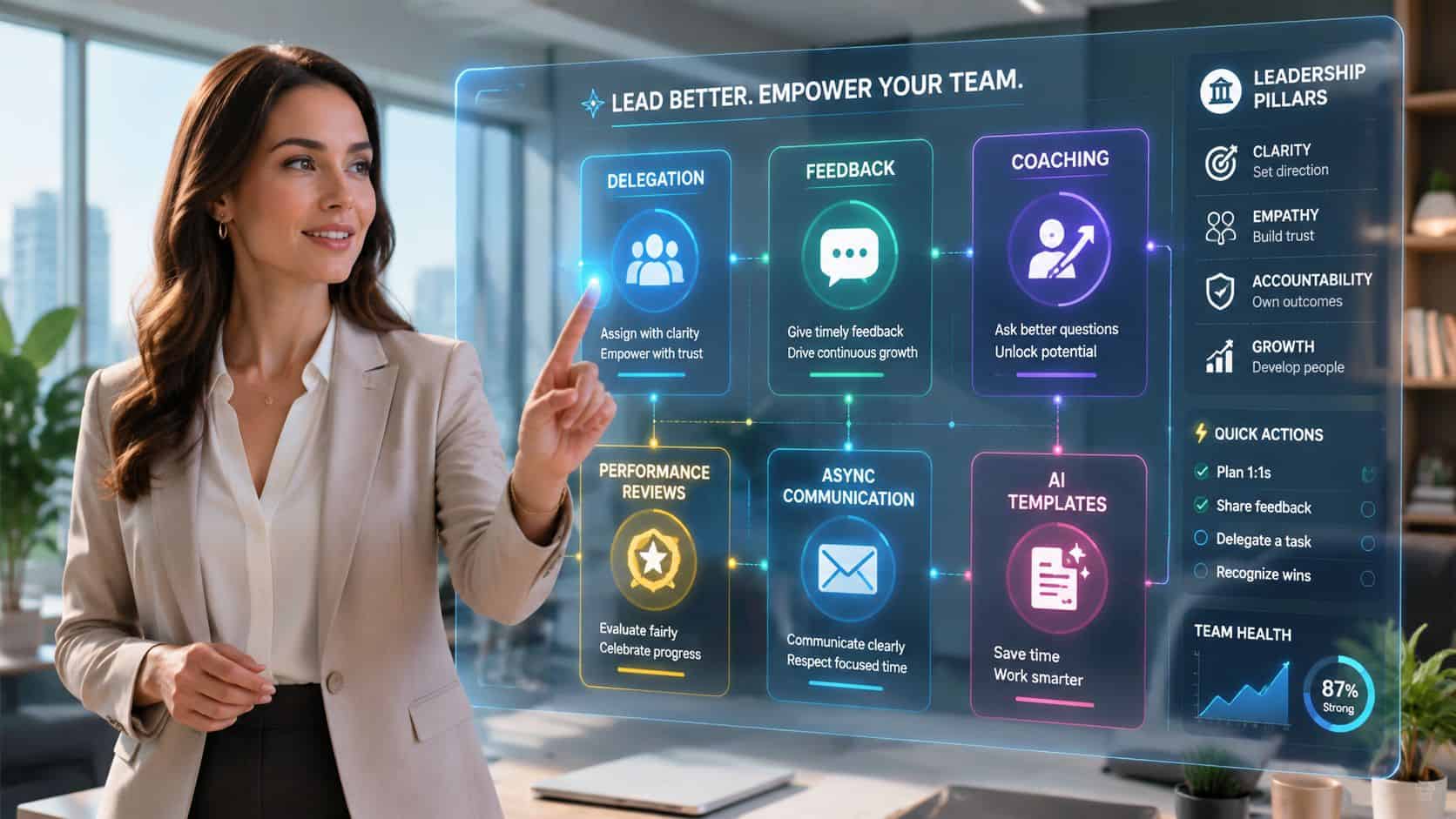
That gap is why so many capable people struggle in the role. They were promoted for being good at the work, then handed a job that isn’t the work at all, with no instruction beyond a few slogans about leadership. Good management isn’t a trait you either have or you don’t. It’s a craft made of specific, learnable practices: setting direction people can follow, delegating without dumping, giving feedback that changes behavior, coaching that builds capability, and managing in every direction at once.
This guide covers that craft in operational terms rather than inspirational ones. It walks through what the job actually requires, the core habits that separate good managers from busy ones, and where AI genuinely helps you do the work versus where your judgment is the only thing that does. None of it depends on being a natural leader. It depends on understanding what the role is really asking of you, and getting deliberate about the parts that matter.
Key Takeaways
- Good management is a craft of learnable practices—setting direction, delegating, giving feedback, coaching, and managing in every direction—not a personality you’re born with.
- The foundational shift is from doing the work to enabling the team; your leverage comes from multiplying people, and the real test is whether the team runs well when you step away.
- Set direction by translating vague slogans like “be proactive” or “higher quality” into observable standards two different people would agree were met.
- Delegate by risk, not by mood: push low-stakes, reversible work out early to build judgment, and keep the irreversible calls until people are ready for them.
- Give direct, specific feedback (drop the sandwich), coach by asking before telling, and use AI as a chief of staff for drafting and prep—never for the judgment or the actual conversation.
Table of Contents
The Job Isn’t What You Think It Is
The most common reason new managers struggle is that they walked in believing management is a personality, and that they either have it or they don’t. The myth says good managers are born with some natural authority, a calm presence, an instinct for people. Plenty of people who become excellent managers had none of that on day one. They learned the job, because it is a job, with practices you can name and get better at.
Three comfortable misreadings of the role tend to do the most damage early, and each one is a strength curdling into a liability.
Mistaking Helpfulness for Management
The first is mistaking helpfulness for management. You were a strong individual contributor, so when work gets hard you do what always worked: jump in and fix it yourself. It feels generous and it feels productive. What it actually does is signal that you don’t trust the person, take away the learning that comes from struggling through, and turn you into the bottleneck every decision waits on. The instinct to help, applied without judgment, quietly becomes interference.
Mistaking Activity for Effectiveness
The second is mistaking activity for effectiveness. A manager can fill every hour, attend every meeting, answer every message within minutes, and still run a team that’s confused about priorities and starved for feedback. Busyness is the easiest thing in the world to perform and one of the hardest failures to spot, because it looks exactly like dedication. The question isn’t whether your week was full. It’s whether anyone on your team had a better week because of how you spent yours.
Mistaking Being Liked for Being Respected
The third is mistaking being liked for being respected. New managers often want to keep the easy peer rapport they had before the promotion, so they avoid hard conversations, soften feedback until it carries no information, and say yes when the honest answer is no. Teams don’t actually trust a manager who won’t deliver bad news. Respect comes from being useful and being straight, and that occasionally costs you a little warmth in the moment. The managers who chase being liked tend to end up neither liked nor respected, because their teams can feel the avoidance underneath the niceness.
None of these traps mean you’re a bad manager. They mean the reflexes that made you successful before the promotion need recalibrating for a role that rewards different things. The shift starts with accepting that your job is no longer to be the best worker in the room. It’s to make the room work, which is a genuinely different skill and the subject of everything that follows. If you’re early in the transition, the first ninety days have their own specific arc, covered in new manager training.
The Core Shift From Doing to Enabling

Every management skill that follows rests on one shift, and it’s the hardest one to internalize. As an individual contributor you were paid to produce. As a manager you’re paid for what your team produces, which means your personal output stops being the point. The work that earned you the promotion is now, at most, a small part of the job, and clinging to it is the single most common way good contributors become mediocre managers.
The shift is uncomfortable because it inverts the things that used to signal success. The instincts that made you valuable now need a deliberate counterweight, and most of the reversals feel wrong before they feel right.
| What worked as an IC | What works as a manager |
|---|---|
| Being the expert with the answers | Asking the questions that get others to the answer |
| Doing the hard task yourself | Building someone else’s capacity to do it |
| Personal productivity | The team’s collective output and clarity |
| Direct control over the work | Influence, trust, and good systems |
Read down the right column and a theme emerges. Your leverage as a manager comes from multiplying other people, not from adding your own effort to the pile. A manager who insists on being the most productive person on the team has capped the team’s output at whatever one person can do, and has usually created a bottleneck where every decision and every tricky task routes back through them. That feels like dedication from the inside. From the outside it looks like a team that can’t move without permission.
The clearest test of whether you’ve made the shift is uncomfortable in its own right: a good manager is working to become unnecessary for the day-to-day. Not unnecessary as in replaceable or idle, but unnecessary as in the team runs well when you’re out, decisions get made without you, and problems get solved before they reach your desk. If the team seizes up the moment you step away, that’s not evidence you’re indispensable. It’s evidence you’ve centralized too much and developed your people too little.
What “enabling” actually looks like in practice is concrete, not abstract. It’s removing the blocker that’s been slowing someone down for a week. It’s making a decision quickly so three people aren’t stuck waiting. It’s setting context so the team understands why the work matters, then getting out of the way on how. It’s noticing that two people keep colliding on the same task and fixing the ownership rather than refereeing every collision. None of that shows up as personal output you can point to at the end of the day, which is exactly why it takes discipline. The work is real. It just doesn’t look like the work you used to do.
Setting Direction People Can Actually Follow
The most underrated management skill is making it genuinely clear what good looks like. It sounds basic until you watch how often it goes wrong. A manager says “let’s be more proactive” or “I want higher quality” or “we need to move faster,” feels like direction was given, and then is privately frustrated when nothing changes. The team didn’t ignore the instruction. They never actually received one, because a value isn’t an instruction and a slogan isn’t a standard.
This matters more than most managers credit, because direction is where leadership leverage is highest. Research out of Stanford’s Graduate School of Business finds that the quality of management explains a meaningful share of the variation in team productivity, and the cheapest, highest-return version of good management is simply making sure people know what they’re aiming at. A team that’s slightly less talented but perfectly clear on the target usually beats a stronger team that’s guessing.
Translate Slogans Into Observable Standards
The fix is to translate every fuzzy expectation into something observable before it leaves your mouth. “Be more proactive” becomes “when you spot a risk to the timeline, flag it in our channel the same day rather than waiting for our 1:1.” “Higher quality” becomes “every customer-facing doc gets a second read before it ships, and the bar is no broken links and no unanswered questions.”
“Communicate better” becomes “post a short status update by Thursday so the rest of us aren’t guessing on Friday.” The test is simple: could two different people read your expectation and agree on whether it was met? If not, it’s still a slogan, and you’ve handed your team a guessing game dressed up as direction.
Connect the Work to Why It Matters
Direction also has a vertical chain that’s easy to drop. Your team needs to understand not just what to do but why it matters and how it connects to the goals above it. When you assign work without that context, you get compliance at best, and people optimize for the literal instruction instead of the outcome you actually wanted.
A few minutes spent explaining where a task sits in the bigger picture buys you judgment later, because a person who understands the goal can adapt when circumstances change, while a person following steps can only follow steps. Setting good direction is also what makes the next skill possible, because you can’t delegate well until the target is clear enough to hand off.
Delegation Is Operating Design, Not Task Dumping
Most managers think they’re delegating when they’re actually just offloading. They take the tasks they don’t want, hand them over with a one-line Slack message, and feel lighter. Then the work comes back wrong, they decide it’s faster to do it themselves, and they quietly stop delegating. The conclusion they draw is that their team can’t handle more. The real problem is that they never delegated, they dumped, and the two look similar only from the manager’s side of the desk.
Dumping Versus Delegating
The difference is entirely in what you transfer along with the task.
| Task dumping | Real delegation |
|---|---|
| Hands over the task | Hands over the outcome and the context |
| “Can you handle this?” | “Here’s what done looks like and why it matters” |
| No authority to decide | Clear scope to make calls |
| Surfaces only when it’s wrong | Has checkpoints built in |
| Keeps the judgment with you | Builds judgment in them |
Dumping moves work off your plate. Delegation moves capability onto theirs, and that distinction is the whole game, because the point of delegating was never just to free up your time. It was to grow the people who work for you, so that next quarter they can handle the thing you can’t hand off yet today.
Delegate by Risk
What you delegate should track the stakes, not your mood. The useful frame is risk. Low-risk, reversible work should go out early and often, with room for the person to do it their own way and even to get it wrong, because that’s where cheap learning happens. Higher-risk work that’s harder to undo gets delegated with more context, clearer guardrails, and a checkpoint or two along the way.
The genuinely irreversible, high-stakes calls stay with you for now, and become delegation targets later as you build the person’s judgment up to them. A manager who delegates only the safe scraps never develops anyone; a manager who delegates a high-stakes decision to someone who isn’t ready yet is gambling with both the work and the person’s confidence. Reading the risk correctly is the skill.
Done consistently, delegation stops being a way to manage your workload and becomes the main way you design how the team operates. Who owns what, who’s growing toward what, where the decision rights sit, how much you stay in the loop: those choices are the actual architecture of a team, and delegation is how you build it. There’s a fuller treatment of the mechanics in this guide to how to delegate as a manager, but the mindset is the part most managers miss. You’re not getting rid of work. You’re deciding who becomes capable of what.
Communication Cadences That Produce Decisions
A manager’s week runs on a few recurring conversations, and whether those conversations are useful or wasteful determines a lot of how the team actually functions. Most managers inherit their cadences by default, keeping whatever meetings existed before them, and never ask whether each one earns its place. The skill is designing the rhythm on purpose, so that each standing conversation has a clear job.
The One-on-One
The one-on-one is the most important and the most often wasted. When a manager gets busy, the 1:1 is the first thing cut, which is backwards, because it’s where you catch problems while they’re still small, keep your read on each person current, and build the trust that makes hard conversations survivable later.
A 1:1 that’s just a status update is a waste of a meeting you could have replaced with a message. The good version goes where status reports can’t: what’s blocking them, what they’re worried about, where they want to grow, what they need from you. The agenda belongs partly to them, and the most useful thing you can do is ask a real question and then stop talking long enough to hear the answer.
Team Meetings
Team meetings have a different job, and the test for them is sharp: did a decision get made, or did people just take turns reporting? Going around the room while everyone recites what they already wrote in the tracker is the most common form of wasted collective time. The better use of everyone being in one place is the work that actually needs more than one brain: a decision with real trade-offs, a problem no single person owns, alignment on a direction that affects everyone. If a meeting could have been a written update, it should have been, and protecting your team’s hours by making that call is itself a piece of good management.
When to Skip the Meeting Entirely
The thread connecting both is that not everything deserves a meeting. A lot of coordination runs better in writing, on the team’s own time, where people can think before they respond and nobody sits through a conversation that didn’t need them. The discipline is matching the channel to the job: the sensitive or developmental conversation goes to the 1:1, the genuine cross-team decision goes to the meeting, and the routine update goes to writing. Get that matching right and the whole week feels lighter, because people spend their time on the conversations that change something and skip the ones that don’t.
Giving Feedback That Lands
Feedback is where a lot of otherwise-decent managers fall down, usually because they were taught a technique that actively gets in the way. The feedback sandwich, a criticism tucked between two compliments, teaches your team that praise is a warning sign and dilutes the one point you needed to land. People leave the conversation remembering the bread and missing the meat. The fix is to be direct and kind at the same time, which most managers wrongly treat as a contradiction.
Drop the Feedback Sandwich
Useful feedback follows a clear path: name the specific behavior, explain its impact, agree on what changes, and set a point to check back. Vague praise and vague criticism both fail for the same reason, which is that neither tells the person what to do differently. Compare the two versions and the difference is obvious.
Weak: “Great job on the presentation.” Better: “The way you opened with the customer problem before the solution kept everyone focused. That’s the structure I’d use on the next one too.” The strong version tells the person exactly what worked, so they can repeat it on purpose instead of by accident.
Weak: “You need to communicate better.” Better: “In the last two standups, the update jumped into detail before anyone had the context, and I watched people get lost. Try opening with one sentence on what the work is for, then go deep.” The strong version names the behavior, the impact, and the change, which is the difference between something a person can act on and something they just have to feel bad about.
The Hard Conversation
The hardest version is the genuinely difficult conversation, the one about persistent underperformance or a behavior problem, and the instinct to delay it is the instinct to manage least well. Those conversations get harder the longer they wait, and the team is almost always aware of the problem before you address it, which means your silence reads as either not noticing or not caring. The approach that holds up is to be specific about the gap, clear about the standard, genuine about wanting the person to succeed, and honest about what happens if nothing changes.
AI can help you prepare for these, pressure-testing your phrasing and rehearsing the hard parts before you’re in the room, an approach covered in this guide to using Microsoft Copilot for performance reviews. What it can’t do is have the conversation for you, because the thing that makes feedback land is that it comes from a person who’s paying attention and is willing to be straight.
Coaching That Compounds Capability
The difference between a manager and a coach is the time horizon. A manager solves today’s problem. A coach builds the person who solves next quarter’s problems without you. Most managers under-invest here because coaching is slow and invisible in the moment, and the payoff arrives later than the quarter you spent it in. But it compounds, and it’s the closest thing to leverage the role offers.
Coach Continuously, Not Annually
The first mistake is treating coaching as an annual event. Real development happens in small, continuous moments, the question asked in a 1:1 instead of an answer handed over, the slightly-too-hard assignment with support attached, the debrief after something went wrong that focuses on what to do differently rather than who to blame. Organizations that build continuous coaching into the manager relationship consistently see stronger engagement and performance than those that save feedback for a once-a-year review, because development that arrives twelve months late isn’t development, it’s a verdict.

Ask Before You Tell
The practical version is to coach by asking before telling. When someone brings you a problem, the fast move is to solve it, and sometimes that’s right. But the developmental move is to ask what they’d do, what they’ve considered, what they’re worried about, and let them reach the answer with you rather than from you. It takes longer the first few times and saves enormous time later, because a person you’ve coached to think it through stops bringing you the same class of problem. Telling creates dependence. Asking builds judgment, and judgment is the thing you’re actually trying to grow.
This is also where a structured plan beats good intentions. Vague encouragement to “keep growing” does nothing; a real picture of where someone is, where they want to go, and the specific assignments that close the gap is what turns coaching into progress. The mechanics of building one are covered in this guide to the employee development plan, but the mindset is what matters most: you’re not managing the person’s current output, you’re investing in their future capability, and the return on that investment is a team that gets stronger instead of just staying busy.
Managing Up and Across
Most management advice points downward, toward your team, but a large part of your effectiveness comes from the directions people rarely teach: up to your own manager, and sideways to your peers. Neglecting either one quietly caps how much good you can do for the people who report to you.
Managing Up Isn’t Politics
Managing up isn’t politics, and treating it as something distasteful is a common way to handicap yourself and your team. It means keeping your manager informed without making them chase you, surfacing problems early instead of hiding them until they explode, understanding what pressures they’re under, and advocating for your people on resources, comp, and growth. A manager who manages up well can shield their team from organizational chaos and win them room to do good work. A manager who doesn’t leaves their people exposed to every gust from above.
The core habits are simple and underused: no surprises on bad news, come with a recommendation rather than just a problem, and translate your team’s needs into the outcomes leadership actually cares about. Organizations increasingly recognize that this upward and outward relationship work is part of the job, and that the manager sits at the center of the employee experience, which is why how you represent your team upward matters as much as how you run it day to day.
Managing Across
Managing across is the other half. Most real work crosses team boundaries now, and your peers in other functions are the people who can unblock your team or quietly stall it. The managers who do this well invest in those relationships before they need them, assume good intent when something goes wrong at a handoff, and treat a peer’s problem as partly their own rather than someone else’s department.
The mechanics of running that cross-team work well are covered in cross-functional collaboration, and when the friction turns into genuine conflict between people on different sides of a handoff, conflict resolution gets more specific about handling it. The throughline is that your job extends well past your own team’s edges, and the managers who pretend otherwise end up wondering why their good work keeps hitting walls they didn’t see coming.
AI as Your Chief of Staff
Every skill in this guide existed long before AI, and good managers practiced all of them without it. What’s changed is that a manager now has something close to a capable assistant on call, one that’s genuinely useful for the administrative weight of the job and genuinely dangerous if you hand it the parts that were always meant to be yours. The right mental model is a chief of staff: it drafts, organizes, summarizes, and prepares, so your scarce attention goes to the judgment only you can supply.
Where AI Earns Its Keep
Where it earns its keep is the work that drains time without requiring your unique read on people. Turning a rough idea into a first-draft message you then edit. Compressing a long thread or report into the decision you actually need to make. Organizing scattered notes from a week of 1:1s into patterns worth acting on. Rehearsing a hard conversation before it’s real. The throughline is that AI handles the draft and the prep, while you keep the decision and the delivery.
Where It Stays Out
The line between those two is the whole skill, and it’s worth being explicit about which jobs get handed over and which never do.
| Hand to AI (with your review) | Keep as yours |
|---|---|
| Drafting updates, messages, and agendas | Deciding what the team should prioritize |
| Summarizing reports and long threads | Judging who’s ready for more responsibility |
| Turning notes into action items | The actual feedback or hard conversation |
| Prepping talking points for a 1:1 | Reading the room and the person |
| Generating options for a low-stakes call | Owning the decision and its fallout |
The danger isn’t that AI gives bad answers. It’s that it gives confident, fluent answers to questions that needed your judgment, and the fluency makes it easy to stop thinking. A manager who lets AI write the performance review from thin inputs ends up with feedback that sounds polished and means nothing, and the employee can tell. The guardrails are simple: feed it real observations rather than asking it to invent them, treat every output as a draft you’re accountable for, and never let it become the voice your team hears instead of yours.
Used well, the better AI gets at the administrative layer, the more of your attention is freed for the parts of management that were always going to be human. The tools that fit this chief-of-staff role share a few traits worth knowing when you choose them, and the broader case for systems thinking in how AI supports a team and the indicators that separate a useful AI workflow from a gimmick are worth a look, as are the coaching-oriented qualities that the best of these tools are starting to support.
The Craft Is Learnable
Look back over everything here and one thing stands out: none of it is personality. Setting clear direction, delegating by risk, giving feedback that names the behavior, coaching by asking instead of telling, managing in every direction, using AI for the administrative weight so your attention goes where it’s needed. These are practices, not traits, and practices can be learned by anyone willing to be deliberate about them.
That’s the part the slogans get wrong. They frame good management as a kind of person you either are or aren’t, which leaves the people who weren’t born calm and commanding assuming the role isn’t for them. The truth is more useful and more demanding. You won’t get there by having the right temperament. You’ll get there by doing the specific things well, noticing where you’re falling back on old individual-contributor reflexes, and correcting course a little at a time.
Nobody does all of this well at once, and the managers who eventually become good at it usually weren’t good at it in year one. They paid attention, took the hard conversations instead of avoiding them, asked for feedback on their own management and acted on it, and treated the role as a craft worth getting better at rather than a status they’d already earned. That’s the whole secret, and it’s available to anyone. Pick the one skill here where you’re weakest, work on it this month, and let the rest follow. The job was always learnable. Most people were just never told that the thing they were supposed to learn had a shape.
Frequently Asked Questions
How do you become a good manager?
You learn the craft, one practice at a time. Good management isn’t a personality you’re born with, it’s a set of specific, learnable skills: setting direction people can act on, delegating to build capability, giving feedback that names the behavior, coaching by asking instead of telling, and managing up and across as deliberately as you manage down. The fastest progress comes from picking the one skill where you’re weakest, working on it for a month, and asking your team for honest feedback on how you’re doing.
What are the most important skills for a manager?
The foundational one is the shift from doing the work yourself to enabling your team to do it, since every other skill rests on it. After that, the highest-leverage skills are clarity (translating vague expectations into observable standards), delegation that transfers ownership rather than just tasks, direct and specific feedback, continuous coaching, and managing your own boss and peers well. Technical excellence in the original job matters far less than most new managers expect.
What’s the difference between a good manager and a bad one?
A good manager makes their team more capable and clear over time; a bad one makes the team dependent on them. The common failure patterns are recognizable: doing the work themselves instead of developing people, mistaking being busy for being effective, avoiding hard conversations to stay liked, and giving vague direction then feeling frustrated when nothing changes. The difference usually isn’t talent or temperament, it’s whether the manager treats the role as a craft worth practicing.
Can someone learn to be a good manager, or is it natural?
It’s learned, almost always. The idea of the “natural leader” obscures how much of good management is specific, practiceable behavior that anyone deliberate can develop. Most managers who become genuinely good were not good in their first year; they improved by taking the hard conversations, asking for feedback on their own management, and correcting course over time. Temperament helps at the margins, but the core of the job is skills, not personality.
How can AI help you become a better manager?
AI works best as a chief of staff for the administrative weight of the job: drafting messages and agendas, summarizing long reports, turning meeting notes into action items, and helping you rehearse a hard conversation before it happens. What it can’t do is the actual management, reading the room, judging who’s ready for more, deciding priorities, or delivering feedback that lands, because those depend on knowing your people. Used well, it frees up time and attention for exactly the human parts of the role that matter most.