
Most advice about cross-functional collaboration is too polite to be useful. Get the right people in a room, clarify roles, communicate openly, and it all clicks into place. That isn’t what line managers actually deal with.
When your team is contributing to a project they don’t own, you’re in the worst seat in the room. Product wants a faster answer. Engineering wants fewer interruptions. Marketing wants certainty before anything is settled. Operations wants process. Leadership wants progress. And you still have a team to run, regular work to protect, and direct reports who need clarity instead of organizational fog.
AI helps with parts of this. ChatGPT, Claude, and Copilot can draft a kickoff brief, turn a chaotic Slack thread into a status update three different audiences can actually use, and convert messy notes into something that looks like a decision. What AI won’t tell you is which VP is quietly blocking the work, whose ego needs handling, or when a “quick alignment meeting” is a turf fight wearing a nicer outfit.
That’s the real job, and it isn’t creating harmony. It’s creating enough structure that the project moves anyway. This guide covers why cross-functional work breaks where it does, why your role is interface manager rather than project manager, how to use AI to set up the work before it gets noisy, and where the political layer starts and AI stops being any help at all.
Key Takeaways
- Cross-functional collaboration fails for structural reasons, not personality — each function is measured on different things and carries a different definition of “done”
- Your real role isn’t project manager but interface manager: protect your team’s capacity and translate vague cross-functional requests into clear, prioritized work
- AI is strongest before the project gets noisy — use it to draft a kickoff brief that exposes gaps, anticipate objections, and build a communication plan early
- Mid-project, use AI to sharpen communication: turn blockers, scope creep, and status updates into clear, factual written artifacts instead of more noise
- AI can’t read the political layer — who’s really blocking a decision or how much capital to spend — so answer those questions yourself before reaching for the tool
Table of Contents
Why Cross-Functional Collaboration Actually Fails
Cross-functional collaboration usually gets blamed on people not getting along. The real cause is structural. Each function is built to want different things: product is measured on shipping, engineering on stability, marketing on the launch landing. Each one works a different clock and carries a different definition of “done,” so when a project crosses between them, the friction that shows up looks personal but almost never is. It’s the structure doing exactly what it was designed to do.
You feel this fast as a people manager. Your team gets pulled into planning by one function, rushed by another, and questioned by a third. Everyone talks about alignment, but few teams actually agree on what success looks like before the work starts. Fewer still agree on who decides when a tradeoff appears. The misalignment doesn’t start in the meeting. It starts earlier, when strategy, incentives, and operating rules stay vague enough that every function can hear a different version of the same plan, which the OKR Hub describes as the gap between strategy and execution.
Projects Break at the Handoff, Not the Middle
Most projects don’t fall apart in the middle of a function. They fall apart at the seam between two of them. Engineering thinks it delivered what was asked for. Marketing thinks the output isn’t usable yet. Design assumed feedback would come earlier. Operations assumed nobody would skip the intake process. Nobody is exactly wrong, but nobody set the interface clearly enough, so each team optimized for its own side of the line and the handoff fell through the gap.
This is why generic “we need better communication” advice rarely helps. Communication is necessary, but it sits downstream of more basic questions. What result actually matters most? Which dependencies are real and which are assumed? What happens if one team misses a date? Who has the authority to decide when two functions disagree? Cross-functional work gets romanticized as teamwork, when in practice it’s mostly a boundary-management problem.
You Get Stuck in the Middle
You don’t own the roadmap, the budget, or the final call. You’re still accountable for whether your team contributes effectively. That gap between responsibility and authority is the specific pressure of cross-functional work, and it shows up in predictable ways. Competing asks, where product wants speed while your functional leadership wants stability. Unclear prioritization, where work arrives stamped “important” from three directions at once. Status ambiguity, where everyone wants updates but no single person is actually running the project. Vocabulary mismatch, where one team talks in campaigns, another in tickets, and a third in risks.
These tensions are manageable, but only if someone makes them explicit early, often, and in writing. Left implicit, they harden into the kind of conflict that costs a month of work. The job isn’t to resolve all of them. It’s to surface them before they turn into a fight nobody scheduled.
Your Job Is Interface Manager, Not Project Manager

The instinct when your team gets pulled into a messy cross-functional project is to step up and quietly run the whole thing. Resist it. Becoming the unofficial project manager for everyone else creates more confusion, not less, and it turns you into a dumping ground for every loose request that nobody else wants to own.
The better model is interface manager. Your job is the boundary between your team’s real capacity and the project’s demands, and the translation of vague cross-functional requests into clear, prioritized work your team can actually deliver. That’s a narrower role than project ownership, but it isn’t a small one.
Protect Capacity
Cross-functional work attracts drive-by requests. “Can your team just take a quick look?” becomes unplanned labor that crowds out the work you already committed to. You have to decide what gets absorbed, what gets deferred, and what needs a real tradeoff conversation. If your team says yes to everything at face value, the loudest function wins your week. Holding that line is easier with a clear delegation system that treats delegation as operating design rather than motivational fluff, so the project work gets absorbed without losing the rest of the week to status churn.
Force Goal Alignment Before Execution
Shared enthusiasm isn’t alignment. Before work starts, push for a plain-language answer to a few questions: what outcome actually matters, what won’t be included, who signs off, and what dependency could stop delivery. The answers feel obvious until you ask, and the silence that sometimes follows is the misalignment you were about to walk into.
Map Dependencies Early
If another team’s input is required, name it before the work begins, not in week three when you’re already blocked. Dependency maps sound bureaucratic until a team loses three days waiting on a decision nobody formally owned.
Report Status Upward and Sideways
In a lot of cross-functional projects, nobody owns communication well enough, so you end up providing the usable signal even when you aren’t running the work. That means reporting current state, the next risk, and the pending decision in a format executives, peers, and contributors can all read without translation.
Translate Between Functions
Engineers and marketers usually aren’t disagreeing on substance. They’re using different language to describe the same risk. A manager who can translate without distorting the meaning becomes far more valuable than one who just relays messages back and forth.
Frameworks Help, But They Don’t Save You
RACI, DACI, cross-functional OKRs. They can all be useful, and none of them fixes weak management discipline. A RACI nobody reads is decoration. A DACI with fake decision authority is theater. Shared OKRs help when teams genuinely share an outcome, not when every function still quietly protects its own local target.
The practical rule is to use the lightest framework that forces the hard conversation. If one durable habit is worth building, it’s converting every incoming request into five things: owner, scope, timing, dependency, and decision path. The format can live wherever your team already works. The discipline of doing it matters more than the template you use.
Using AI to Align the Team Early
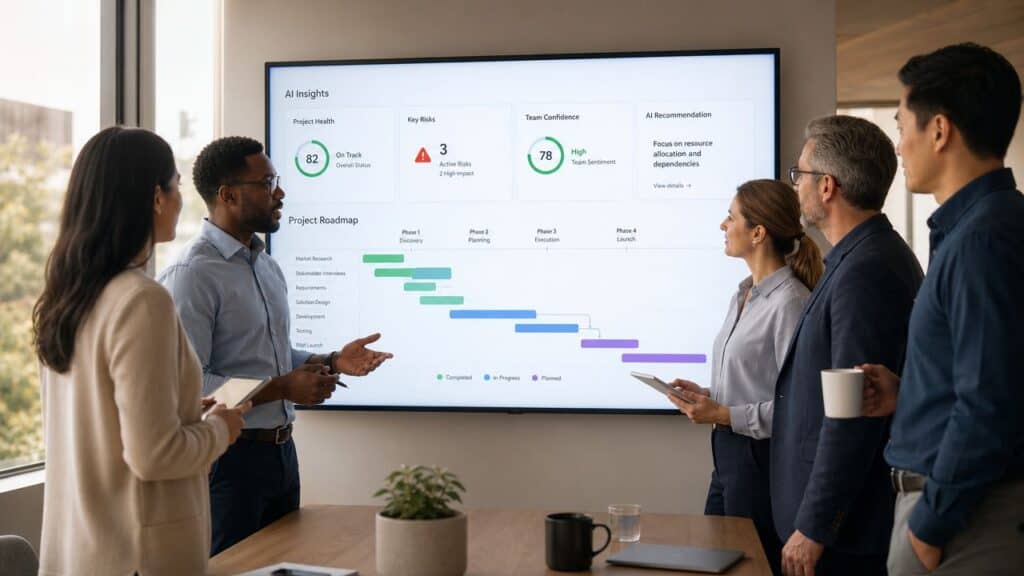
The best time to use AI on a cross-functional project is before it feels busy. Once the calendar fills up and the Slack channels get loud, most of the damage is already done. AI is strongest at turning messy inputs into a cleaner first draft, and a project kickoff is mostly messy inputs: scattered notes, half-formed assumptions, and the polite ambiguity nobody wants to challenge out loud.
Build the Kickoff Brief That Forces Gaps Into the Open
Say you get pulled into a kickoff with product, design, engineering, and marketing. There’s a loose brief in a shared doc, a few Slack comments, and a calendar invite with no real agenda. That’s the moment to feed your current notes to ChatGPT, Claude, or Copilot and ask for a structured brief. The useful version isn’t a glossy summary. It’s a document that drags the missing information into view.
Review these notes for a cross-functional project kickoff. Create a brief with these sections: business outcome, in-scope work, out-of-scope work, proposed owners, dependencies by function, open questions, likely conflict points, decisions needed before start, and risks if assumptions are wrong. Write in plain language for engineering, marketing, and operations leaders.Get that into the shared doc before the meeting, not after. It changes the kickoff from opinion-trading into gap-finding, which is the only thing a kickoff is actually good for.
Anticipate the Objections Before the Room Does
Most kickoffs waste time because nobody wants to raise the obvious objections too early. AI has no such hesitation, which makes it useful for pressure-testing the plan before you walk in.
Act as four stakeholders in this project: engineering manager, product manager, marketing lead, and operations lead. Based on this brief, list the top objections each is likely to raise, the assumptions behind them, and what evidence or clarification would reduce the resistance.That gives you a checklist. Engineering worries about hidden technical dependencies, marketing about launch certainty, operations about the support burden, product about scope drifting before work even starts. Knowing which objection comes from where lets you address it in the brief instead of getting ambushed in the room.
Design the Communication Plan Before Anyone Asks for Updates
Cross-functional projects often fail because communication gets built reactively. People wait until confusion shows up, then start bolting on meetings. A leaner plan drafted at the start prevents most of that.
Using this project brief, generate a communication plan with audiences, update cadence, channel, owner, and purpose. Keep synchronous meetings minimal. Assume distributed teams across functions and include how decisions will be documented.The point of doing this early isn’t using AI more. It’s getting clean project artifacts in place before confusion hardens into conflict. If you want your whole team building this habit rather than relying on you to prompt every time, structured AI training for employees moves the needle more than one-off prompting ever will.
AI Workflows for Mid-Project Problems
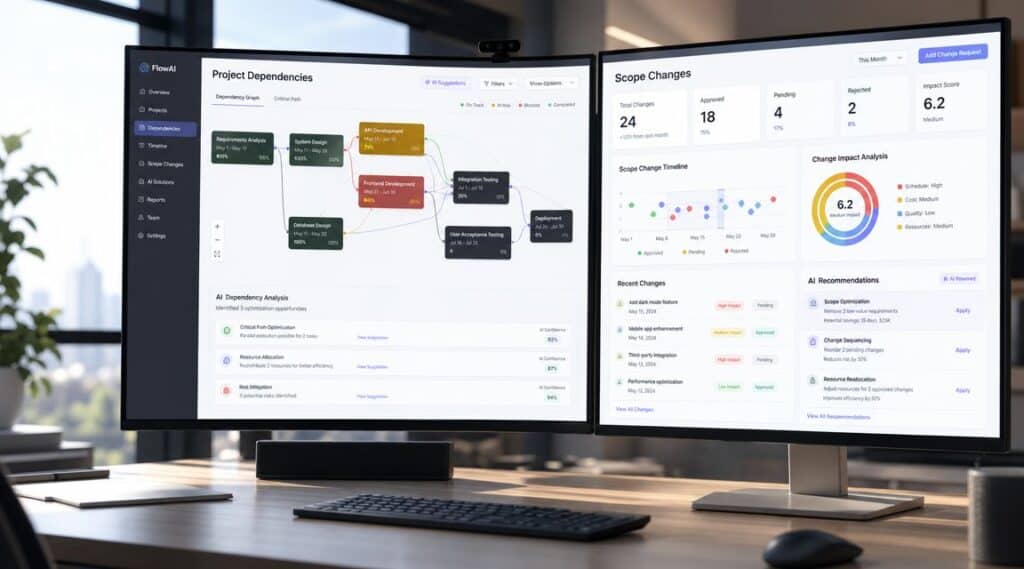
Once a project is moving, your job shifts from alignment to pressure management. AI still saves time here, but only if you use it to sharpen communication rather than generate more noise. Three mid-project situations come up constantly, and each has a clean AI workflow.
A Dependency Is Blocking Your Team
Your team can’t move because another function hasn’t delivered an input, approved a requirement, or answered a question that’s been sitting in the tracker for days. The worst response is a passive-aggressive nudge. The second worst is silence while your team stalls.
The better move is to turn the blocker into a factual note with impact, owner, next step, and timing. Feed the relevant ticket, the Slack context, and your real deadline to ChatGPT or Claude.
Draft a concise message to the owner of this dependency. Tone should be direct, calm, and non-accusatory. Include what is blocked, why it matters, the latest date we need a response to avoid downstream delay, and two options for resolving it. Avoid blame language.That prompt matters because most managers either soften the message until it’s ignorable or harden it until it triggers defensiveness. The note that works names the impact and the timing without making it personal, and it keeps the project tracker as the source of truth while the message just points back to it.
Scope Creep Arrives From Another Function
Your team started on one brief. Halfway through, another function adds a “small request” that quietly changes review cycles, asset needs, or implementation complexity. AI is useful here for reframing this as a tradeoff instead of a personality conflict.
Compare this new request against the original project brief. Identify changes to scope, likely downstream effects, dependencies added, and decisions that need revisiting. Give three response options: absorb with tradeoffs, defer to a later phase, or decline as out of scope. Write it for cross-functional stakeholders.The framing is the whole game. You don’t need AI to say no for you. You need it to show what yes would actually cost. Once the tradeoff is visible on paper, the conversation gets cleaner, and it usually lands better as a short written note than as a tense moment in a meeting, because it gives the other function something concrete to react to instead of a vague “this feels bigger than you think.”
Status Reporting When Nobody Is Fully in Charge
This is where managers lose the most time. There’s a Slack thread, a meeting transcript, scattered notes, and three different audiences all asking for an update. That’s ideal summarization work, and it’s one of the highest-leverage things AI does on a project.
Use this transcript and these Slack messages to create three status updates: one for executives, one for technical contributors, and one for cross-functional stakeholders. Keep the facts consistent across all three, but adjust language, detail level, and focus for each. List unresolved decisions separately from general progress.One source, three audiences, consistent facts. The executive version leads with decisions and risks, the technical version with blockers and owners, the cross-functional version with handoffs and open questions. There’s a fuller set of ChatGPT prompts for project updates that fits this exact use, and the broader benchmark for keeping functions working off the same truth comes down to messaging for coordination and a project system for accountability, a split Outreach describes well in its cross-functional best practices.
Where AI Can’t Help: The Political Layer
Everything above is the part AI is good at. It can clean up language, summarize a conflict, and draft an escalation note in seconds. What it can’t do is tell you how much political capital to spend, and that’s the variable that actually decides whether a cross-functional project moves.
The limit shows up most clearly when a decision has stalled and several functions are waiting. On paper it looks like a communication problem. In reality it’s usually an authority problem wearing a communication costume. The most durable view of cross-functional work treats this as a governance question rather than a messaging one, which is how UMN frames it: collaboration that holds up starts with leaders across functions sharing ownership of outcomes instead of defending only their own departmental targets. When that shared ownership is missing, no amount of well-drafted communication fixes it, because the problem was never the wording.
A Stalled Decision Is a Judgment Problem, Not a Writing Problem
Say product and engineering have been circling the same decision for a week. Marketing needs an answer. Your team can’t finalize its piece until it’s resolved. AI will draft the escalation email instantly, and that’s the easy part. The hard questions are the ones it can’t answer for you. Do you escalate in writing or start with a private message? Do you go to the project lead, both functional heads, or your own manager first? Is the delay genuine uncertainty, or a turf dispute nobody wants to name out loud? Will a formal escalation clarify ownership, or just trigger defensiveness that sets things back further?
Those are reads on people and timing, not drafting problems. AI has no access to the private conversation you had last week, the history between those two functions, or the fact that one of the leads is already under pressure for an unrelated miss.
Where AI Becomes an Actual Risk
Managers get into trouble when they use AI to generate communication they haven’t politically thought through. A polished escalation note is still the wrong move if it bypasses someone who expected to be consulted. A neutral summary can still inflame things if it makes one team’s caution look like incompetence. A “balanced” AI draft can flatten context you already know from a hallway conversation, and send a cleaner message that lands worse.
This is one of the most common ways managers misuse the tool: reaching for efficiency when the situation actually calls for courage, timing, and a read on the room. It’s worth understanding the broader pattern of how managers misuse AI, because the mistakes usually start as management errors before they become AI errors. The practical guardrail is sequence. AI belongs after you’ve answered three questions yourself: what outcome do I need, whose support actually matters, and what channel gives the best shot at movement. Skip those and the polished draft just helps you make the wrong move faster.
For the upward end of these conversations specifically, where you’re escalating past your own boss or managing how leadership perceives the stall, the same care applies as in any other form of managing up with AI. The tool prepares the message. You still own the decision about whether, when, and to whom.
A Resilient System Beats a Charismatic One
The managers who keep cross-functional work stable are rarely the loudest or the most framework-heavy. They build something their team can lean on when priorities shift, another function goes quiet, or leadership changes its mind midstream. For you, that system isn’t about owning the project plan. It’s about protecting your team from preventable chaos.
The durable version has a few simple parts. A written definition of success with clear scope boundaries and an explicit sign-off path. A visible dependency map, wherever your team already works, so everyone can see what’s blocked and who owes what to whom. A translation layer that converts technical updates into stakeholder language and stakeholder requests into work your team can execute. And an honest read on your team’s bandwidth, because cross-functional systems usually fail when every function assumes the others have hidden capacity. Good managers correct that assumption early.
None of it holds without people willing to surface risk before it becomes a fire, which is why psychological safety matters at the operating level, not just the culture level. Distributed cross-functional work runs on written updates and careful escalation, and if people expect to get punished for raising concerns, they’ll wait too long and soften the bad news until it’s too late to act on. The research on this is consistent: Atlassian’s work on collaboration ties highly collaborative environments to meaningfully higher job satisfaction and lower turnover intent. The practical version is simpler than the numbers. Bad collaboration drains teams. Good collaboration gives you room to keep yours effective without the organization’s confusion spilling straight onto them. It’s also one of the quieter reasons people stay, as this guide to retaining employees explains.
AI helps with the clerical load underneath all of this. It drafts the brief, clusters the dependencies, reshapes the status update for three audiences. What it can’t do is read the incentives, hear what isn’t being said, or decide when to push privately versus publicly. A resilient system doesn’t remove the politics. It gives you earlier signals, cleaner handoffs, and a better chance to step in before the politics waste a month of work. That’s the job. Not harmony, just enough structure that good work survives contact with the org chart. Clearing that load also matters for morale, a theme in these employee engagement ideas.
Frequently Asked Questions
What is cross-functional collaboration?
It’s when people from different functions, like product, engineering, marketing, and operations, work together on a shared project none of them fully owns. The difficulty is that each function is measured on different things and uses a different definition of “done,” so the friction is structural, not personal.
Why do cross-functional projects fail?
They usually break at the handoff between functions, not inside any one of them. Each team optimizes for its own side of the line, and the interface between them stays vague: unclear ownership, unnamed dependencies, no agreement on who decides when there’s a conflict. Better communication helps only after those basics are settled.
How can AI help with cross-functional collaboration?
AI is good at the structural work: drafting a kickoff brief that exposes gaps, turning a messy thread into a status update for different audiences, and reframing scope creep as a visible tradeoff. Use it before the project gets noisy, and to sharpen communication rather than generate more of it.
Where does AI stop being useful?
At the political layer. AI can’t read who’s really blocking a decision, judge how much capital to spend, or decide whether to escalate in writing or in private. The more political the situation, the less you should outsource the first-draft thinking. Answer what outcome you need, whose support matters, and which channel works before you reach for the tool.